
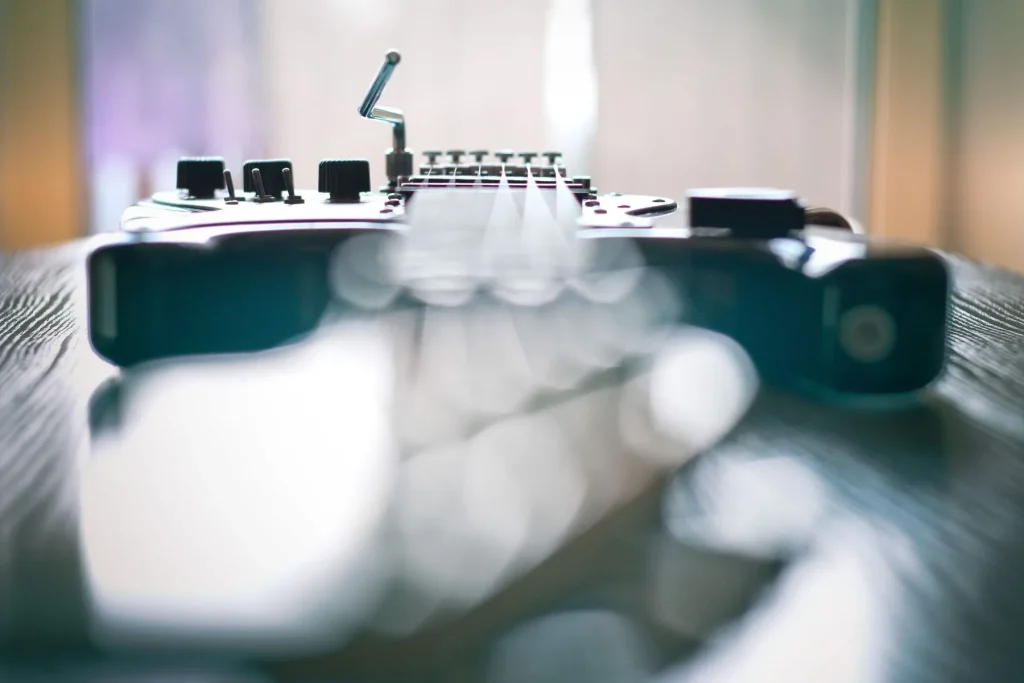
Asking yourself this question helps clarify what you want to play. These two instruments have distinct sounds and functions.
The bass occupies the low register and provides the rhythmic and harmonic foundation. The six-string guitar covers the middle and high registers, often carrying melodies and solos.
Famous lines such as Another One Bites The Dust and Money show the impact of a strong bass line. Bassists are often in demand for bands, which matters if you want to play with others.
The learning methods are similar: finger positions, theory and timing carry over from one instrument to the other. If you are unsure, take time to try both instruments.
For a detailed comparison, consult this comparison guide, which covers history, technique, budget and learning.
Guitar and bass: quick definitions and historical background
The history of these instruments helps explain why one provides the foundation and the other often carries the melody.
The modern form of the classical guitar emerged in nineteenth-century Europe. It later developed into amplified models. With the arrival of solid bodies, the Telecaster popularized the solid-body electric guitar and changed how amplified bands played.
In the United States in the early 1950s, Leo Fender designed the Precision Bass. It was intended to replace the double bass, which lacked volume onstage. This four-string electric bass soon became a standard.
A guitar’s standard tuning is E-A-D-G-B-E (EADGBE). A bass is tuned E-A-D-G (EADG), one octave lower. This difference in register explains the distinct roles of their notes and the bass’s rhythmic function.
Although it is often called a bass guitar, the bass is closer in its role to the double bass. The difference between the two instruments is much like that between a violin and a double bass.
Finally, both instruments share approaches to fingering and fretboard positions. This helps musicians communicate and leads into the following discussion of strings, necks and frets.
Key differences between the two instruments
The number of strings, string gauge and construction all affect how each instrument is played.
Number of strings, tunings and note range
The standard configuration has six strings on a guitar (EADGBE) and four on a bass (EADG), tuned an octave lower. Five- and six-string variations extend the range.
Neck, frets, string gauge and tuning machines
Typical string gauges are around 10–46 for guitar and 50–105 for bass. The bass has sturdier tuning machines and construction.
Size and ergonomics: everyday playing comfort
On a bass, the neck is longer, the frets are farther apart and the strings have wider spacing. This supports rhythmic precision but requires adjustments to your playing.
- Practical tip: try the instruments sitting and standing, with a strap, to get a feel for the neck and weight.
- Transferable skills: positions on the four lowest strings are similar, making it easier to switch between bass and guitar. To learn more, read this detailed comparison.

Roles in a band and tonal character
A song’s balance often depends on how its low and high registers interact.
The bass as the rhythmic and harmonic backbone
The bass supports the beat alongside the drums. It anchors the harmony and provides a foundation for everything else.
When the bass stops, the song loses its foundation. Even when it is less audible in styles such as metal, its absence is immediately noticeable.
Guitar: rhythm, melody and solos
The guitar provides rhythm, chords and melody. Onstage, it often takes the solos and draws the audience’s attention.
For a good sound, the guitarist and bassist need to build the rhythmic foundation together and leave room for the other instruments.
Famous examples and how the parts interact
Lines such as Another One Bites The Dust and Money show how a bass can carry a song with its low notes.
Similar tuning on the lower strings makes it easier for bassists and guitarists to interact. Their parts can answer, imitate or complement one another.
| Function | Sound | Example |
|---|---|---|
| Rhythmic foundation | Low-end support and stability | Another One Bites The Dust |
| Rhythm and melody | Texture and attack | Solos and chords |
| Interaction | Responses and reinforcement | Dialogue between bassist and guitarist |
- Tip: listen to mixes that bring the bass forward to train your ear.
- Analyze arrangements of familiar songs to identify how the roles are divided.
- Remember that the bass can also take solos, depending on the style and the player.
Learning, techniques and progress
You can progress quickly when you connect theory with practice from the start.
Transferable skills: scales, chords and note positions work similarly on both instruments. Studying the same scale helps you remember intervals and notes, while tablature helps you practise on either instrument.
Common techniques: fingerstyle and pick playing provide a shared foundation. Legato (hammer-ons and pull-offs) and tapping can be practised in both registers. Slap is typical of bass but can enrich any musician’s playing. Sweeping, however, is less comfortable on thicker strings with wider spacing.
Progress and styles: aiming to play Nirvana requires less virtuosity than aiming to play Steve Vai or Jaco Pastorius. Your desired level and style determine how much time to invest.
- Regular, gradual practice: 20 to 45 minutes a day are enough to make progress.
- Formats: private lessons (around €20–40 per hour), group lessons, apps and online courses.
- Resources: YouTube can help, but a structured course and feedback during lessons are better.
You can start at any age. Choose an instrument that suits your body and try different repertoires to find a sound you like. For practical equipment advice, see this bass buying guide and this guide to choosing your first acoustic guitar.

Budget, equipment and accessories for beginners in France
To get started, you need an instrument that is comfortable to play, a suitable amp and a few essential accessories.
Starting prices and bundles
Approximate prices: an entry-level electric guitar starts at around €180.
A small amp costs between €80 and €170. A complete beginner bass bundle with an amp costs around €250–350.
Essential accessories
A reliable tuner, picks of different thicknesses, a comfortable strap and a padded gig bag are essential.
Consider a capo for guitar and a spare set of strings to avoid interruptions.
Amps, Amplug and ways to learn
A compact amp is enough at first. The Amplug is a practical way to play through headphones without disturbing others.
To make progress, combine private lessons (€20–40 per hour), group lessons, online resources and apps.

| Item | Approximate price | Purpose |
|---|---|---|
| Entry-level instrument | Around €180 | Good playability for beginners |
| Beginner amp | €80–170 | Volume and basic effects |
| Bundle with amp | €250–350 | Ready-to-use beginner setup |
| Essential accessories | €30–70 | Tuner, strap, gig bag, strings |
Practical tip: prioritize playability and comfort over premium equipment. Compare instruments in a shop and consult a beginner’s guide to find the one that best suits your budget.
Bass guitar or electric guitar: which should you choose?
The role you want to play in music and your circumstances often determine the best choice.
Your goals: rhythm, melody, solos or playing in a band
If you want to focus on rhythm and keeping the group together, the bass is a strong choice. Bassists are in high demand in bands and provide a song’s framework.
If you prefer melodies and solos, the electric guitar will suit you better. Guitarists often draw attention onstage.
Your comfort: neck size, string gauge and stamina
The longer neck and heavier strings affect stamina. Try several models sitting and standing to find one that suits your level.
Your circumstances: musical styles, local bands and budget
Consider your style (funk, rock, jazz or metal), the local music scene and your budget. A beginner bundle may cost less, while opportunities to join a band may also guide your choice.
- Tip: try both instruments to resolve your uncertainty: a few hours can sometimes be enough.
- Suggestion: talking with a bassist and a guitarist you know can help you picture yourself playing.
- Remember: the best choice is the one that makes you want to play most.

Conclusion
In short: register, ergonomics and role define how the two instruments are used.
The difference lies in their tunings (EADGBE versus EADG), string gauges (around 10–46 versus 50–105), necks and frets. All of these affect playing comfort and the techniques involved.
The fundamentals transfer between instruments: scales, positions and theory help you progress. Consider the total cost (instrument, amp or Amplug, accessories and lessons) before buying.
Listen to recordings to distinguish the sounds, much as you would compare a violin and a double bass. Try the instruments in a shop and practise for a few months: the right one is the one you want to play every day.
To explore the available models, consult the best bass guitars for beginners and choose one that suits your style (rock, metal or funk).