
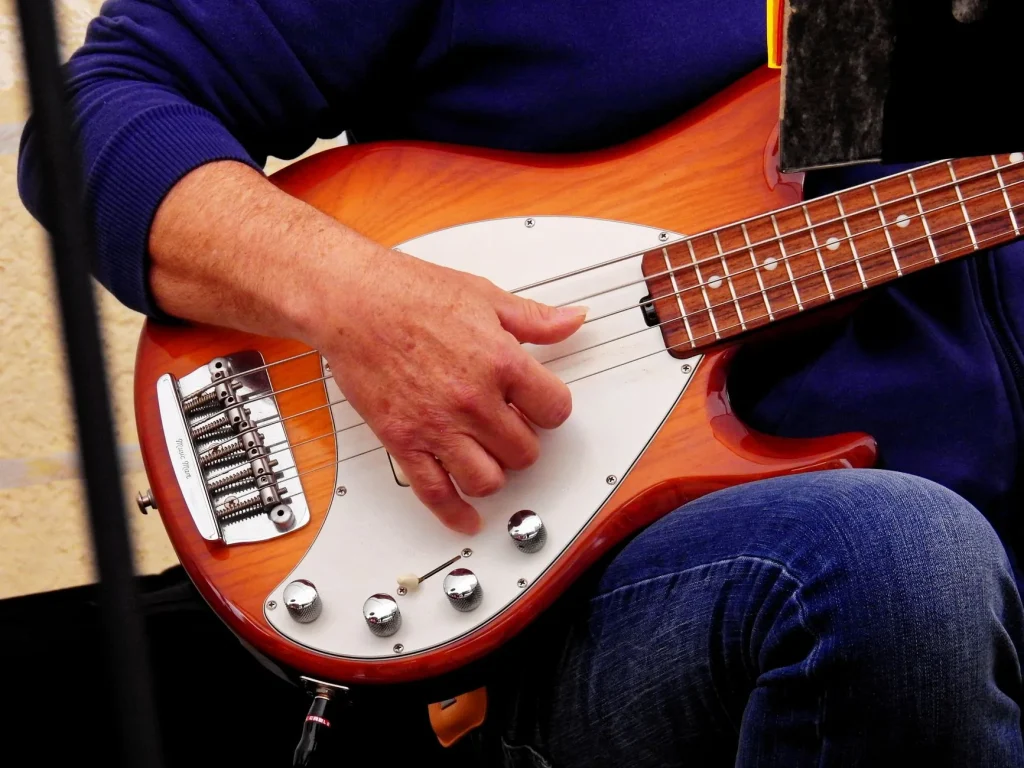
Goal of this guide: explain step by step how to tune a bass so it sounds right alone or with a band.
Why it matters: humidity, temperature and transport can change pitch. An out-of-tune string affects sound quality and how well musicians play together.
The modern reference pitch is A at 440 Hz. You may see note names written as do, re, mi or as C, D, E, F, G, A, B. The letter names are useful because tuners often display them.
Standard tuning is E A D G for four strings and B E A D G for five strings. Adjacent strings are tuned in fourths, which helps explain how they relate to one another.
We will cover several methods: a tuner (clip-on, pedal or cable-connected), the fifth fret and harmonics. Following a structured method improves accuracy and helps you tune faster.
For a tutorial dedicated to tuning a five-string bass, see this five-string bass guide.
Why tune your bass and understand standard tuning?
A well-tuned bass immediately gives the groove more presence and clarity. When the notes are out of tune, the sound becomes muddy, even when you play alone. In a band, every musician needs to use the same pitch reference to avoid clashing sounds.
Immediate effects on sound and playing with a band
An out-of-tune string makes chords less distinct and unsettles the rhythm. The mix loses clarity, and the song can sound less cohesive.
When playing along with recordings, use A at 440 Hz as your reference. It gives musicians a shared pitch so they can play together smoothly.
Note names and ear training
Two naming systems are used: do, re, mi, fa, sol, la, si and C, D, E, F, G, A, B. Letter names are more common on bass guitar tuners.
Getting used to A at 440 Hz sharpens your sense of relative pitch. With regular practice, you will tune your bass more consistently and confidently.
| Configuration | 4 strings | 5 strings |
|---|---|---|
| Standard notes | E A D G | B E A D G |
| Why use it? | Progression in fourths; a logical fretboard pattern | Extended low range |
To learn more about reading notes, see bass guitar notes. Your instrument should be tuned before every session to give you a solid starting point.
How to tune a 4-string bass step by step
First, stabilize your instrument and prepare your tuner for an accurate reading. Set the bass down, check that the tuning pegs turn freely and make sure each string moves smoothly through the nut and over the bridge.
A simple procedure using a tuner
- Connect the tuner with an instrument cable, turn the bass volume all the way up and choose the string to tune.
- Pluck the string gently, wait for the needle or display to settle, then turn the tuning peg in small increments.
- If the note is sharp, loosen the string; if it is flat, tighten it.

By ear, using fourths
Use the fifth fret as a reference: the fifth fret of the E string gives you A, the fifth fret of the A string gives you D, and the fifth fret of the D string gives you G.
For greater precision, compare the fifth-fret harmonic on one string with the seventh-fret harmonic on the next string. Listen for beats to detect small differences in pitch.
Final checks
Check each string again after the first pass: string tension can rebalance and change the tuning.
Play octaves and bass lines in different positions to check the pitch of notes across the fretboard.
| Model | Type | Recommended use |
|---|---|---|
| Tiger JT-12B | Pedal | Stage use, easy to see |
| Anpro GT-1 | Clip-on | Quick and convenient for rehearsals |
| Rockboard ST-01 V2 | Pedal | Durable, easy to read on stage |
Bass guitar tuning: 4 and 5 strings step by step
A fifth string adds useful low notes, enriching bass lines and extending your range. The standard B E A D G tuning uses the same letter names found in the C D E F G A B system displayed by most tuners.
Why add a B string?
The low B string gives you access to lower notes without transposing. It allows deeper bass lines and a continuous range of notes across the fretboard.
Alternative tunings and creative options
Depending on the style, you can tune the strings lower for a deeper sound or use a pattern such as D G C F on a four-string bass. These choices change the sound and playing range.
Practical adjustments
String tension, action and tuning pegs: choose a string gauge that provides the tension you want. If the action is too high, playing becomes difficult; if it is too low, you may hear unwanted buzz and weak notes. Smooth-turning tuning pegs improve stability.
| Element | Advice | Effect |
|---|---|---|
| Tuning pattern | B E A D G (C D E F G A B) | Easy to read on the tuner; extended range |
| String gauge | Choose one suited to the desired tension | Consistent tension and stable intonation |
| Action | Set it to a comfortable height | Comfortable playing with less unwanted buzz |
Styles such as jazz, rock, pop and funk can use the extended range to create richer bass lines. An easy-to-read tuner remains essential in the studio and on stage.
Tuning tools: electronic tuners, tuning forks and online options
The right tools save time and provide consistent accuracy.
Tuners come in three practical formats. Clip-on models attach to the headstock and detect vibrations. They work well in noisy places.
Pedal tuners fit into an effects chain and can mute the signal on stage. Cable-connected tuners plug directly into the bass for rehearsals; turn the instrument volume all the way up for a clear reading.
An A 440 tuning fork and ear training
A tuning fork produces a clear A at 440 Hz. It is an excellent way to learn to recognize a note without looking at a screen.
In practice: repeat the note, then adjust the strings by ear.
Online tuners
Online tools are quick and accessible. GLAAC, for example, offers a free interface designed for bass.
“A simple, reliable tool removes guesswork and helps you settle your sound before every session.”

| Format | Advantage | Recommended use |
|---|---|---|
| Clip-on (Anpro GT-1) | Unobtrusive; detects vibrations | Rehearsals and noisy rooms |
| Pedal (Rockboard ST-01 V2) | Stable reading on stage | Concerts and effects chains |
| Cable-connected or budget pedal (Tiger JT-12B) | Affordable and simple | Beginners and rehearsals |
In summary: combine a reliable tuner, a tuning fork for ear training and an online tool for quick checks and clear information about your strings.
Tuning stability, maintenance and troubleshooting
Keeping notes in tune takes a few simple, regular steps. Changes in temperature and humidity affect string tension and pitch. Transport can jostle the tuning pegs and cause strings to slip.

Temperature, humidity and transport: keeping your instrument stable
Keep your instrument in a protective case when traveling. If you have come from a hot or cold environment, let it acclimate for a few dozen minutes before playing.
Check the tuning before each session, then check it again after 10 to 15 minutes of playing. This routine corrects initial shifts and helps the notes stay in tune.
Inspection, lubrication and adjustments
Check the tuning pegs, nut and bridge. Neat string windings and a little lubrication at friction points help the bass stay in tune. Replace worn strings that no longer hold their pitch.
A recommended routine for bassists
- Tune your bass with a reliable tuner before every rehearsal and concert.
- Check the tuning again after a few minutes of playing.
- Adjust the action to suit your string gauge and avoid unwanted buzz and friction.
Consistency comes with experience: repeating these steps may feel tedious, but it improves sound quality and reduces surprises on stage. For practical advice on equipment, see a tuner comparison such as the best tuners, or read this detailed guide to instrument maintenance.
Conclusion
Conclusion
The best habit is to check intonation by playing bass lines across the whole fretboard. Start with A at 440 Hz as your reference, then tune one string at a time. Check octaves and make another quick pass to confirm the tuning.
Remember: standard E A D G and B E A D G tunings are your reference points. A fifth string adds useful low notes without changing your basic fingering patterns.
Use a suitable tuner (clip-on, pedal, cable-connected or online) and train your ear. Simple care of the tuning pegs and strings helps notes stay in tune. Choose the tuning method that suits your situation and play with confidence.