
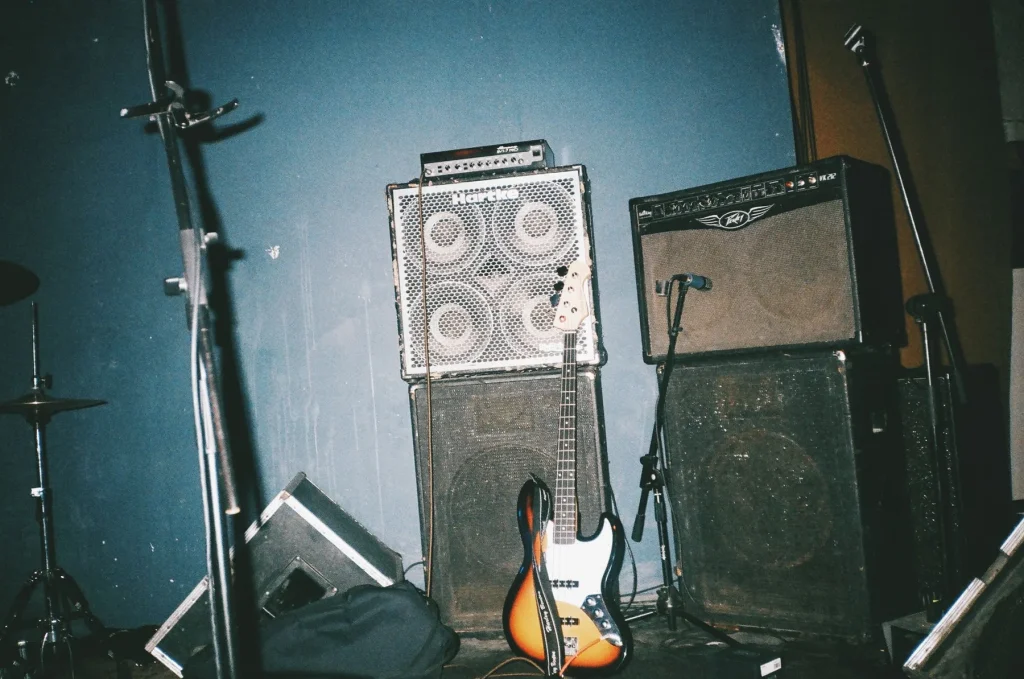
A simple question with a nuanced answer. According to discussions in a French-language forum thread, there are several practical ways to connect two instruments to one sound system.
To switch between instruments, an A/B box such as the Morley ABY avoids frequent unplugging and protects the input. Some prefer a Boss LS-2 router to mix two sources with separate volume controls.
To play at the same time, a small mixer (such as a Behringer) or the LS-2 lets you control both volumes and send a clean signal to one device. Amps with two inputs, such as the Fender Bassman, are also suited to this use.
Be careful with a Y splitter: several users report impedance, level and noise problems. Keep the EQ flat and adjust volume at each source to avoid damaging the speakers.
Understanding the limits: bass amps, guitar amps and frequency handling
Low frequencies put more strain on the speaker. They move more air, so the speaker cone must travel farther than it does with a guitar. At the same power level, this raises the risk of the cone bottoming out and causing mechanical distortion.
What happens if you plug a bass into a guitar amp? The sound often lacks low end because the cabinet and filtering favor mids and highs. Turning up the volume can damage the speaker or cause unwanted distortion.
Active and passive inputs and independent channels
Some circuits accept two sources through active and passive inputs, but the gain varies by manufacturer. Truly independent channels with separate preamps are still the best way to connect a guitar and bass at the same time without compromising the sound.
| Criterion | Guitar amp | Bass amp |
|---|---|---|
| Frequency response | Favors mids and highs | Designed for deep bass |
| Ability to handle speaker excursion | Low to moderate | High (12/15″ cabinet) |
| Suitable for simultaneous use | Possible, but risky | Often better tolerated |
Practical tip: keep the EQ flat and adjust the volumes at each source. Adding a -10 dB pad or a line pedal helps prevent input overload.
Bass and guitar: can they share the same amp?
The short answer today: yes, but only with suitable routing and a few simple precautions.
The short answer today: yes, with precautions and suitable routing
Yes, you can connect two instruments to one system if you avoid improvised connections.
- Switch cleanly between them with a dedicated A/B box to avoid pops and signal loss.
- To play together, choose an active router (such as the Boss LS-2) or a small mixer.
- If the device has independent inputs, use them instead of a passive Y splitter.
- Keep the EQ flat and set the level at each source to preserve headroom.

“An active summing device is better than an improvised Y splitter: it protects the sources and reduces noise.”
| Solution | Benefit | Drawback |
|---|---|---|
| A/B box | Clean switching | Does not allow simultaneous playing |
| Active router / LS-2 | Separate volumes and mixing modes | Additional cost |
| Independent inputs | Better handling of both instruments | Uncommon on small combo amps |
How to do it: safe ways to connect a guitar and bass to the same amp
First, decide what you want to do: switch between instruments or play them simultaneously. The method depends on your needs and the equipment available.
Switch cleanly: an A/B box such as the Morley ABY switches between two instruments connected to a single input. It helps prevent pops and protects the jack.
Playing together without damage
An active router such as the Boss LS-2 lets you set two volumes independently and has a mix A+B mode. It is useful for combining a guitar and bass without overloading the input.
A small mixer (such as a Behringer) gives you more control: gain adjustment, EQ for each channel and an output to the amp.
Recommended settings
- Keep the amp’s EQ flat.
- Set the volumes at the sources and adjust levels at each stage of the signal chain.
- Watch the guitar’s highs and the bass’s lows to protect the speaker.
Practical examples and pitfalls
Y splitter: it is inexpensive but often ineffective. Users report level loss, impedance interactions and noise.
“An active summing device is better than an improvised Y splitter: it protects the sources and reduces noise.”
| Solution | Benefit | When to use it |
|---|---|---|
| A/B box (Morley ABY) | Clean switching | Quick changes on stage |
| Active router (Boss LS-2) | Mixing and separate volumes | Playing together without a mixer |
| Small mixer (Behringer) | Precise gain control | Multiple sources and instruments |
| Amp with two inputs (such as a Bassman) | Independent channels | Use at low or moderate volume |
Conclusion
Sharing one system is possible if you use suitable routing and manage levels carefully.
To switch between instruments, use an A/B box (such as the Morley ABY). To play together, choose an active router (Boss LS-2) or a small mixer. These options let you adjust the volumes separately and limit noise.
Keep the device’s EQ flat and set levels at each source. Avoid Y splitters: they often cause impedance interactions and signal loss.
Amps with independent channels (such as the Bassman) remain ideal. If you are unsure, choose two small amps: it is simple, safe and convenient.