
What this guide offers: it will help you choose between two related instruments by explaining the differences that matter when buying or renting your first one.
The modern instrument known as the “classical” guitar emerged in Europe in the 19th century. The electric bass arrived in the early 1950s with Leo Fender’s Precision Bass. This history shows that each instrument was designed for a particular role.
Tuning: a standard guitar is tuned E-A-D-G-B-E. A bass is tuned E-A-D-G, one octave lower, which changes how it feels to play and how you hear songs.
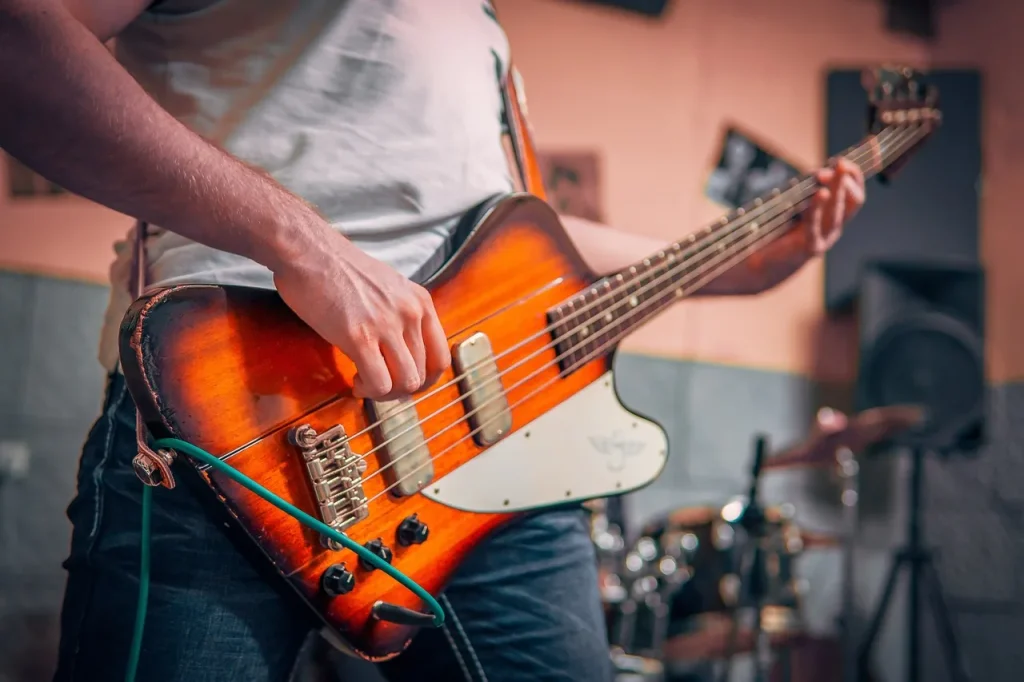
Look at the size, neck length, large tuning machines and string thickness: these are immediate visual clues for a beginner.
On stage, the bass forms the rhythmic backbone alongside the drums, while the guitar can provide rhythm, melody or solos. The sections below cover ergonomics, pitch range, techniques and opportunities to play in a band.
Read on for listening tips and iconic bass lines that will help you narrow down your choice.
Understand the purpose of the comparison to choose your first instrument
Choosing your first instrument starts with deciding what sound and musical role you want.
Goal: clarify your priorities: are you drawn to the groove of low notes or to higher melodic patterns?
The learning methods are similar: scales, arpeggios and reading tablature transfer readily from one instrument to the other. Their construction is similar too: body, neck, tuning machines, pickups and controls, although the bass is often larger and heavier.
This guide compares the instruments point by point to make their differences concrete and useful when choosing. It also considers how long it may take to reach a level where you can play at rehearsals.
Beyond the instrument itself, consider your preferred style, your role in a band and your physical comfort. The sections below offer practical points of comparison and musical examples to help you decide which instrument suits your tastes and plans.
| Criterion | Key point | Effect on your choice |
|---|---|---|
| Sound | Low and high notes | Shapes what you listen for and the musical role you choose |
| Ergonomics | Size, weight, comfort | Affects how regularly you practise |
| Learning | Transferable scales and tablature skills | Makes it easier to move between instruments |
Bass or guitar: what are the differences for beginners?
These two kinds of instrument differ noticeably in construction and feel.
Construction and ergonomics:
A longer, thicker neck, large tuning machines and a heavier body are typical of a bass. These features support heavier-gauge strings (for example, 50–105), while a standard guitar uses thinner strings (for example, 10–46).

In practice, the strings are farther apart and the frets are more widely spaced. This changes the precision needed from your fretting hand and the force needed from your plucking hand.
Tuning and pitch range
The bass’s tuning (E-A-D-G) uses the same note names as four strings of the guitar (E-A-D-G-B-E), but the bass sounds one octave lower. The physical sensation of the vibrations and the instrument’s place in a mix are therefore very different.
Number of strings and gauge
Quick visual clues: a standard bass has four strings, while a standard guitar has six. Thicker strings need a firmer touch; an electric guitar responds more readily to bends and gentle vibrato.
| Feature | Bass | Guitar |
|---|---|---|
| Neck | Longer, thicker | Shorter, thinner |
| String gauge | 50–105 (example) | 10–46 (example) |
| Number of strings | 4 (5 or 6 are also possible) | 6 (sometimes 12) |
If you are still undecided, read our guide to choosing your first acoustic guitar: it offers practical pointers that are useful even if you are considering a bass.
Role in a band and on stage
On stage, each musician’s role becomes clear in how they anchor the tempo and contribute to the character of a song.
Rhythm section and harmony — The bass and drums form the backbone of a song. The bass anchors the groove and supports the harmony. Without it, the low end sounds empty, even if the audience does not always notice it.
The guitar moves between chords, rhythmic patterns and melodic lines. It often takes the solos and featured passages. Together, these instruments support the vocals and the song’s energy.
Visibility and stage presence — The bassist stands near the drummer to keep the pulse steady. Many bands have one bassist and two guitarists. The spotlight often follows a guitarist during a solo, but the bass carries the band’s shared energy.
“When a bass line disappears, it leaves an immediate gap in a song.”
Listen to the introduction of Another One Bites the Dust to hear how a simple line can carry an entire section.
Finally, would you rather be a bassist, a quiet but essential anchor, or a guitarist, more visible and often called on for the big moments? For a closer comparison, see this practical guide to the differences between the instruments.
Learning, difficulty and the path to progress
The prospect of playing at rehearsals quickly appeals to many beginners, but learning either instrument is more nuanced than it first appears.
Getting started: it is often easier to reach a level suitable for rehearsing simple grooves on bass. Early rock or pop parts call for clear timing and short patterns.

Easier at first? Getting started versus mastery
Feeling that you are progressing quickly does not mean the path to virtuosity is shorter. The musicians mentioned here — Jaco Pastorius and Billy Sheehan on bass, and Steve Vai on electric guitar — show that reaching a high level of technical skill takes years.
The idea that “fewer strings means easier” is misleading: timing and precision matter from the first songs you play.
| Aspect | Getting started | Long-term mastery |
|---|---|---|
| Time before playing in a band | Short (a few weeks) | Years to develop finesse |
| Technical complexity | Moderate | High (virtuosity is demanding) |
| Suggested repertoire | Rock and pop standards | Advanced transcriptions |
Consistency matters: 10 to 20 minutes of daily practice is better than one long session each week.
Choose your instrument according to what motivates you. If you want guidance on starting bass, read this guide to becoming a bassist.
Playing techniques and stylistic range
The range of playing techniques varies greatly with the instrument and style you choose.

Bass techniques
Fingerstyle playing: a rounded, articulate sound that is ideal for groove. A pick produces a sharper attack.
Slap: percussive playing with modern accents. It changes note placement and rhythmic flow.
Electric guitar techniques
A pick helps with speed and precision in riffs. Fingerpicking helps you play independent musical lines.
Solos carry melodic tension; guitar is often chosen for these passages.
Transferable techniques and their limits
Legato, tapping, scales and arpeggios transfer well between the instruments. This makes it easier to learn both.
Sweeping, which flows smoothly on guitar, feels less natural when the strings are thick and widely spaced.
| Technique | Suitability for bass | Suitability for electric guitar |
|---|---|---|
| Fingerstyle playing | Excellent | Very good |
| Pick | Good for a strong attack | Ideal for fast riffs |
| Slap | A signature rhythmic technique | Rare; used for specific effects |
| Sweeping | Limited suitability | Highly suitable |
“Note placement and the use of silence often define the groove as much as technique does.”
Try the same riff on both instruments to hear where each sound sits in the mix.
How to choose according to your goals, your ear and your personality
Your ear will often guide your choice: are you looking for a deep groove or a melody that supports the vocals?

Are you drawn to groove and low notes, or to melodies and solos?
Listening tip: if low notes and keeping the rhythm appeal to you, bass may suit your tastes.
If riffs, chords and solos excite you, guitar may give you more ways to express yourself.
Opportunities to play in a band in France
Many bands look for bassists. Starting on bass may let you join a band sooner and take part in more projects.
Many bassists play in several bands at once. A bassist often stands near the drummer and works on the foundations of a song.
- Try both instruments for a few days, paying attention to their weight, how the strings respond and how they feel to play.
- Consider your goals: anchoring the band’s energy or stepping forward for solos.
- Remember that you can play both instruments: you could consider switching between them after a few months.
| Criterion | Bassist’s advantage | Guitarist’s advantage |
|---|---|---|
| Joining a band | Often quicker | More competition |
| Role on stage | Rhythmic foundation | Melodic presence |
| Creating music at home | Very good with a looper | Quick to explore with effects |
“Choosing an instrument that fits your interests and available time helps you stay motivated.”
Conclusion
In short, the two instruments share a common foundation but serve different needs.
The main differences between them are their pitch range, ergonomics — neck length, number of strings and string gauge — and role in a band.
Bass provides the rhythmic foundation (listen to Another One Bites the Dust and Money), while electric guitar often draws attention with solos.
Reaching a good level takes time and regular practice. Bassists often find more opportunities to play, but a guitarist who pays attention to the band’s shared role is valuable too.
Try both, listen for the sounds you prefer and get started. For practical advice on choosing a lower-pitched instrument, see our guide to choosing your first bass.