
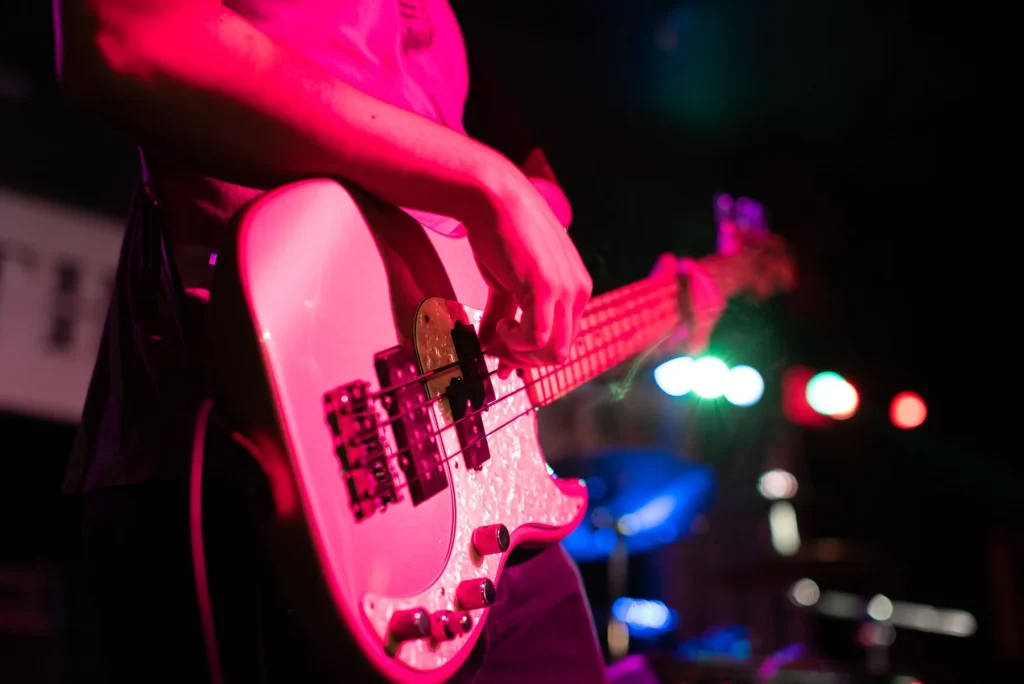
Purpose: this guide explains why a fretless bass appeals to musicians. It covers its advantages and disadvantages, then shows where the instrument shines today.
A simple definition: a fretless bass has no metal frets. Its sound is singing and cello-like, and it responds closely to the player’s touch.
Many modern bassists are drawn to its range of subtle sounds. The instrument allows slides, microtonal intervals and a degree of expression that is difficult to achieve on a fretted bass.
What this article offers: a clear overview of its strengths and limitations, with practical advice on equipment, models and budget. The guide moves from its appealing sound to playing techniques, then to brands and the final choice.
Who it is for: curious readers, fretless beginners and experienced bassists. It combines practical points with artist references to connect theory and practice.
Clarity and objectivity: you will learn what works well and what presents problems, so you can make an informed decision.
Why the fretless bass appeals today
The appeal of a fretless bass begins with its voice, which resembles human singing. Direct contact between the string and the wooden fingerboard creates a more organic sound. Slides and vibrato become expressive tools that can add color to a melodic line.
Over the years, bassists such as Hans Naves and Jaco Pastorius have demonstrated the instrument’s potential. Their playing has taken the fretless bass beyond jazz. Today it appears in pop, rock, film music and even metal.
Playing it requires precision and a good ear. But the effort pays off: your playing gains nuance. Depending on its role in the mix, a fretless bass can remain subtle or take center stage.
“Removing the frets reveals harmonics and offers a different range of expression.”
| Characteristic | Sound | Common use |
|---|---|---|
| Singing tone | Voice-like sound, nuanced sustain | Melodic lines, solos |
| Slides and vibrato | Natural expression | Jazz, fusion, pop |
| Demanding technique | More difficult intonation | Requires practice, which also benefits fretted playing |
- Originality: a distinctive tone appreciated by today’s audiences.
- Versatility: fits into many genres.
- Connection to sound: more organic and less constrained by frets than a fretted model.
Fretless bass guitar: strengths, limitations and styles
Choosing a fingerboard without frets changes the way every note breathes.

Greater expression: vibrato feels natural, slides are smooth and harmonic richness increases, especially with roundwound strings.
Effect on notes: pitch is no longer set by frets. Finger placement and subtle adjustments to intonation become creative tools. Phrasing becomes more vocal and adds color to the mix.
Main disadvantages
Accurate intonation demands precise finger placement, especially in the higher register. Slap loses some punch because the string strikes the fingerboard rather than metal, and sustain decreases.
| Aspect | Effect | Solution |
|---|---|---|
| Intonation | More demanding | Ear training, fingerboard markers |
| Slap | Less percussive | Appropriate strings and EQ |
| Mix | Singing character | Studio use or intimate live settings |
In a band, this instrument creates melodic lines that connect harmony and rhythm. In the studio, a fretless bass can lead or accompany, depending on the intended role.
Signature sound and playing techniques
The tone of a fretless instrument comes from direct contact between string and wood. On a smooth fingerboard, lengthwise vibrato and slides provide fine control over intonation. Slow vibrato colors a note; a continuous slide creates almost vocal passages.
Vibrato, slides and the color of notes under your fingers
Vibrato: practice a steady movement, first slowly and then quickly, to control pitch and expression.
Slides: practice short intervals, then wider ones, to train your ear and stabilize intonation.
How strings, fingerboard and neck interact: wood, sustain and attack
The hardness of the fingerboard changes its resonance: ebony provides precision, while rosewood adds warmth.
Roundwound strings increase harmonics and sustain. Flatwound or tapewound strings soften the attack and protect the fingerboard.
| Element | Influence | Practical advice |
|---|---|---|
| Fingerboard type | Precision or warmth | Choose according to the tone you want |
| Strings | Harmonics and attack | Roundwound for brightness, tapewound for a velvety sound |
| Picking-hand position | Definition or fullness | Play near the bridge for attack, near the neck for warmth |
Control unwanted noise by muting the strings with both hands. To improve, practice controlled vibrato, slides across precise intervals and double stops to train your ear.
To learn more about choosing your first instrument, see this guide.
The learning curve: playing in tune and playing better
Finding the right place for your fingers on a smooth fingerboard takes a methodical approach and careful listening. Precise intonation remains the main challenge, especially in the higher register.

Fingerboard lines or an unmarked neck: visual guides and your ear
Markers, lines or side dots offer reassurance at first. They help your hand find positions and stabilize your first notes.
A completely unmarked neck forces your ear to take over. In time, this improves your sense of pitch and the musicality of your playing.
Recommended posture: keep your wrist aligned, play on your fingertips and breathe calmly. This position improves precision and helps prevent tension.
Suggested practice routine:
- Practice with a metronome in fixed positions.
- Use a drone to work on intonation.
- Play slow scales and sustained notes to check pitch.
Playing with a light touch rather than forcing the attack makes transitions clearer. Recording your bass lines helps you identify pitch errors and adjust finger placement.
Ultimately, the discipline learned on this instrument improves precision on a fretted bass, sharpens your ear and frees your musical expression.
Musical styles: from jazz and pop to metal
On stage and in the studio, a fretless fingerboard gives arrangements a distinctive voice. It has a natural place in jazz, especially through the legacy of Jaco Pastorius, where melodic lines become short, singing solos.
Pop and rock: smooth countermelodies and expressive layers can support a singer without overwhelming the guitar. Sting showed how a clear, melodic bass line can serve the song.
Metal and heavy metal: with suitable amplification and precise playing, a fretless bass creates an organic contrast on stage. Avoid excessive slides to keep the riff clear.
- Role in the band: prioritize articulation to maintain impact in the low frequencies.
- Managing the mix: use focused EQ to place the bass between the kick drum and distorted guitars.
- Playing approach: fingerstyle playing, controlled vibrato and subtle effects such as light chorus and moderate compression.

| Genre | Use | Advice on strings and effects |
|---|---|---|
| Jazz and fusion | Melodic lines, harmonic role | Roundwound strings, subtle chorus |
| Pop and rock | Countermelodies, layered textures | Tapewound or flatwound strings, light compression |
| Metal and heavy metal | Strong contrast on stage | Roundwound strings, careful midrange EQ |
In short, a fretless bass suits many musical styles if the playing remains clear and the amplification is well managed. The instrument offers valuable tones in service of the music.
Players and recordings for inspiration
Several influential musicians have shaped the distinctive voice of the fretless instrument, each offering a technical and musical lesson.

Jaco Pastorius remains the pioneer. He popularized the instrument in the 1970s with his modified Jazz Bass. His articulation, harmonics and melodic phrasing are essential listening.
Sting and pop rock
Sting shows how the bass can serve a song. Listen to “Every Little Thing She Does Is Magic” to study singing lines that still support the band.
Modern virtuosos: Gary Willis and Steve Bailey
Gary Willis, often playing a five-string bass, and Steve Bailey, playing a six-string, demonstrate the instrument’s range and technical possibilities. Their approaches offer lessons in rhythmic placement and control of dynamics.
Textures and expression
Percy Jones and John Giblin bring a variety of tonal colors. Their work shows how varying attack, sustain and timbre can enrich a bass line.
What you can learn from these players: control of intonation, command of phrasing, and choices about picking-hand position and strings. Study memorable bass lines, transcribe them and adapt these techniques to your playing.
| Artist | Contribution | What to hear |
|---|---|---|
| Jaco Pastorius | Harmonics, melodic phrasing | Portrait of Tracy, School Days |
| Sting | Pop-rock playing, singing lines | Every Little Thing She Does Is Magic |
| Gary Willis | Five-string technique, modern groove | Excerpts from From the Sun to the Moon |
| Steve Bailey | Extended six-string range, virtuosity | Solos and collaborations |
| Percy Jones and John Giblin | Textures, subtle accompaniment | Studio sessions and solo tracks |
Finally, compare their equipment and brand choices if you want to recreate some of their sounds. Listening closely to these examples can speed your progress and inform your choice of bass.
Equipment and setup: strings, pickups, fingerboard and neck
Equipment and setup often make the difference between an expressive line and a muddy recording.
Choosing strings: roundwound strings offer more sustain and harmonics. They add brightness and help solos stand out.
Flatwound or tapewound strings protect the fingerboard and soften the attack. They suit a delicate playing style and reduce wear.
Fingerboard and neck: an ebony fingerboard provides precision and a crisp attack. Rosewood gives a warmer color.
The neck profile, its rigidity and the levelness of the fingerboard affect comfort. Good stability helps preserve accurate intonation across the neck.
Pickups and electronics: modern models offer single-coil pickups, humbuckers or Bartolini pickups. Some also have a piezo pickup to broaden the tone.
Active two-band EQ lets you adjust bass and treble quickly. A passive setup emphasizes natural clarity and dynamics.
Practical settings: adjust the high-pass filter gently to avoid a muddy sound. Shape the midrange to bring the bass forward and use enough treble for articulation.
| Element | Effect | Advice |
|---|---|---|
| Roundwound strings | Brightness, long sustain | For solos and harmonic richness |
| Tapewound or flatwound strings | Soft feel, fingerboard protection | For light, comfortable playing |
| Ebony or rosewood fingerboard | Precision or warmth | Choose according to the tone you want |
| Pickups and electronics | Color and response | Bartolini pickups for fullness, active EQ for shaping the sound |
Models, brands and budget: choosing the right fretless bass
The right balance depends on ergonomics, electronics and price. In France, there are affordable models for beginners and more refined instruments for stage or studio use.
Entry-level and midrange models
Entry level: the Harley Benton JB-40FL offers excellent value for money if you want to try fretless playing without spending too much. It suits a limited budget.
Midrange: the four- or five-string Sire/Marcus Miller V7 FL offers active and passive Heritage-3 EQ. The Cort B4 FL MHPZ includes a practical preamp for stage and studio.
More advanced models
The Ibanez SRF700/705 and SRH505F-NNF stand out for their Bartolini pickups and robust electronics. These models suit both studio and stage, with four-, five- or six-string options depending on the range you need.
Buying criteria
- Ergonomics: neck profile and body balance.
- Weight: essential for long periods of standing.
- Use: prioritize stable intonation for studio work and reliable electronics for live performance.
- Price: budget according to the range you choose.
| Range | Models | Key points |
|---|---|---|
| Entry level (< €600) | Harley Benton JB-40FL | Value for money, a good starting point |
| Midrange (€600 to €1,000) | Sire V7 FL, Cort B4 FL MHPZ | Active and passive EQ, built-in preamp, more refined construction |
| Higher range (€1,000 to €1,100 and above) | Ibanez SRF700/705, SRH505F-NNF | Bartolini pickups, suited to studio and stage, four-, five- or six-string options |
Practical advice: check fingerboard alignment, response across the neck and consistent intonation. To narrow your selection, also consult bass comparisons such as the best electric basses.
Fretted or fretless: which suits your needs?
The choice mainly depends on the role you want the bass to play in the music. Do you want a sharp attack to drive the groove, or a line that breathes and sings?
Advantages of a fretted bass: easier intonation, punchy slap thanks to the frets, and an immediate attack. It helps a bassist establish a clear rhythmic foundation.
Advantages of a fretless bass: greater expression, continuous slides and natural vibrato. The nuances available under your fingers offer a different tonal palette.
Playing context and role in the band
For pop, rock or funk where slap is central, a fretted bass may be the better choice. For jazz, fusion or melodic layers, a fretless bass may be preferable.
Trying both under the same conditions, with the same strings and amplification, helps you choose. A musician may also keep both instruments for different needs.
If you are a beginner, start with a fretless bass that has visual markers: they can make the transition to precise intonation easier.
| Criterion | Fretted | Fretless |
|---|---|---|
| Intonation | Easy | Demanding |
| Slap | Very effective | Less percussive |
| Expression | Limited | High |
Conclusion
Ultimately, the search for a distinctive tone guides the choice between precision and freedom.
The fretless bass has a distinctive sound, particularly suited to melodic lines and organic textures. Its advantages are clear: expression, vibrato, slides and harmonics. Its disadvantages are real, too: demanding intonation and less percussive slap.
The choice of components—strings, fingerboard, neck, pickups and body top—affects the sound of the notes, projection and comfort. Look beyond price: try instruments in person, compare their specifications and play them through the same amp.
Tip: make a shortlist based on string count, listen to Jaco, Sting or Gary Willis, and practice regularly. With work, playing becomes more natural and the fretless bass finds its place in jazz, pop, rock or contemporary music.