
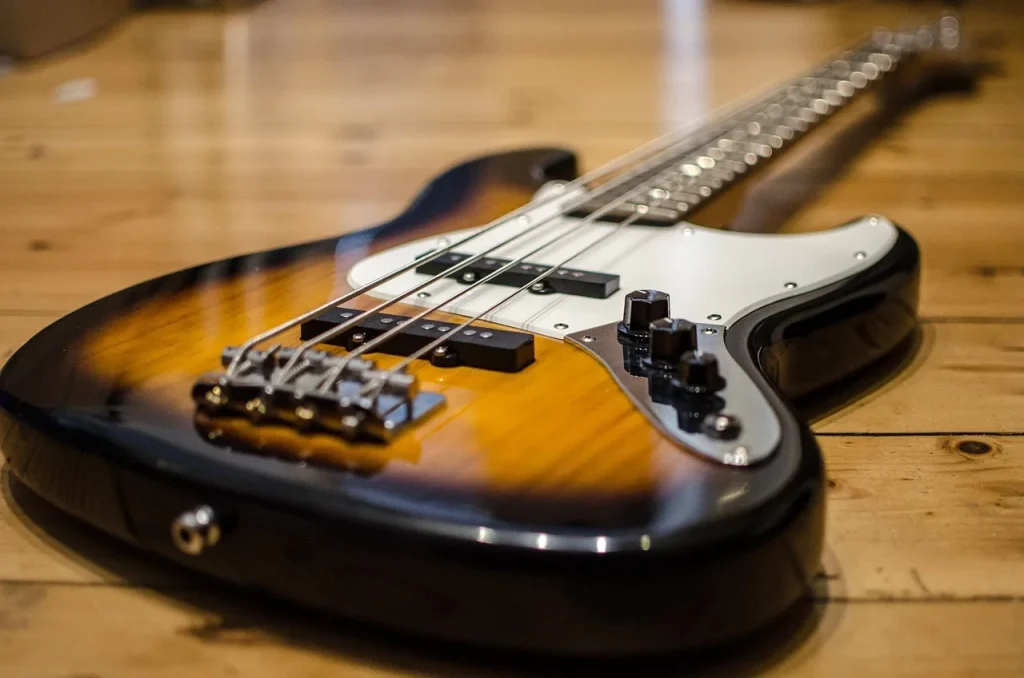
The Rickenbacker 4003 remains an obvious choice when definition, punch and presence are essential. Its long sustain, bright highs and Ric-O-Sound output give it an instantly recognizable sound that anchors a bass line in the mix.
The maple body and neck-through construction, rosewood fingerboard and two single-coil pickups account for its distinctive tone. The switchable Vintage Tone circuit brings back that Chris Squire-style treble. This instrument can move from mellow warmth to bright clank, depending on its settings.
Our aim: to help you choose according to your setting, whether in the studio, on stage or playing with a band. We look at this Rickenbacker bass’s strengths and limitations, and why it anchors bass lines so effectively in rock, prog, pop, metal and funk.
Some finishes, such as Midnight Blue, are also very rare, which interests musicians and collectors alike. Below, we put the bass through its paces, style by style.
Our quick take on the Rickenbacker 4003 for today’s styles
From the first notes, this model makes its character clear with a sharp attack and generous sustain.
Overall verdict and sound
The verdict is clear: the Rickenbacker 4003 excels when a bass needs to cut through a mix without losing definition. Its mids are articulate, its highs bright and its lows solid.
On stage or in the studio, pairing it with a good amp and a Tech 21 SansAmp broadens its range. The bridge pickup provides bite; the neck pickup supplies weight.
Who it may not suit
If you always want a very subdued, neutral P-Bass-style sound, this model may feel too distinctive.
Settings that call for very deep, sustained lows may require EQ or suitable strings. Even so, its build quality, low action and tuning stability make it a dependable instrument at any playing level.
Rickenbacker: Which Bass Styles Does It Suit?
When choosing this instrument, start by deciding what you want from its sound: presence in the mix or a more discreet role. That guides your choice and your settings from the first take.
The 4003, successor to the 4001, stands out for its sustain and clear highs. Its two single-coil pickups and stereo Ric-O-Sound output let you separate the signal from each pickup. That opens up processing and amplification options in the studio.
On stage, it excels in rock and prog, where melodic bass lines need to carry. Combining the volume and tone controls for both pickups with the Vintage Tone circuit lets you shape its brightness and attack to suit the mix.
For very mellow fingerstyle songs, a few changes will help: more flexible strings and EQ to soften the mids. Compared with other basses, this instrument projects the mids and articulates notes particularly well, a real advantage when you want to cut through the mix.
Key 4003 specifications and their effect on sound
Its dimensions and component choices shape its attack, sustain and brightness.
Pickups and outputs: two single-coil pickups provide transparency and a crisp attack. This pickup type brings out detail and responds dynamically, allowing you to shape the mids.
Scale length, frets and fingerboard
The 33 1/4″ (84.5 cm) scale length and 20 frets give it a compact feel without sacrificing sustain. The attack stays lively, especially near the bridge.
The unfinished rosewood fingerboard softens the attack and gives you finer control over harmonics.
Neck, body and bridge
The neck-through construction and maple body provide rigidity and efficient energy transfer. The result is punch, brightness and solid lows.
The bridge supports accurate intonation and consistent sustain on this instrument.
| Specification | Detail | Effect on sound |
|---|---|---|
| Pickups | 2 single-coil pickups | Transparency, crisp attack, articulate mids |
| Outputs | Mono + stereo Ric-O-Sound | Separate routing for bridge-pickup compression and EQ |
| Scale length / frets | 84.5 cm / 20 | Compact feel, sustained notes, dynamic attack |
| Woods | Neck-through construction & body: maple; fingerboard: rosewood | Punch, brightness and a smooth feel |
String tip: roundwounds add sparkle, while flatwounds smooth the transients. Your string choice fine-tunes where the mids sit in the mix.
Construction, woods and craftsmanship: what they change in the mix
The combination of woods and construction directly affects how the bass line cuts through a mix.
The maple body and neck-through neck provide a density that supports clarity and sustain. In a dense arrangement, the attack remains distinct and the lows retain a firm foundation.
Maple and other woods: brightness, sustain and projection
Maple projects more brightness than alder or basswood. This increases the bass’s presence in a band.
In practice, a gentle cut in the upper mids may be enough to keep notes from sounding too harsh.
Unfinished Caribbean rosewood fingerboard: feel and tone
The unfinished Caribbean rosewood fingerboard softens the attack. It feels more organic than a finished maple fingerboard.
The result is less raw treble and a warm tone that helps this bass remain musical in the studio and on stage.

| Element | Feature | Effect in the mix |
|---|---|---|
| Neck-through construction | Maple, skunk stripe | Continuous vibration, sustain and even notes |
| Body | Solid maple (~4.1 kg) | Projection, crisp attack, solid lows |
| Fingerboard | Unfinished Caribbean rosewood | Warm feel, softer attack |
| Luthier setup | Fret leveling / neck adjustment | Less unwanted noise, better studio takes |
The role of the two pickups and Rickenbacker bridge
The interaction between the pickups and bridge shapes the sound’s character and projection. The two single-coil pickups cover complementary parts of the frequency spectrum. The bridge transfers energy and supports stability and intonation.
Neck pickup: weight and fullness
The neck pickup adds weight and warm harmonic body. It anchors the lows and strengthens the rhythmic foundation.
Useful for long, sustained lines, it smooths the harmonics without hiding the attack.
Bridge pickup: definition, bite and “clank”
The bridge pickup emphasizes the upper mids. It delivers definition, bite and the characteristic “clank” that cuts through a distorted mix.
In percussive parts, it supplies impact and clarity among the guitars.
- Blend the two pickups: adjusting their volumes and tone controls balances weight and bite. Small changes affect both the feel under your fingers and the amplified sound.
- The bridge’s effect: efficient transfer, accurate intonation and sustained harmonics are essential for a clean studio recording.
- Output settings: use the mono output for simplicity, or stereo Ric-O-Sound to process each pickup separately (EQ, compression, distortion).
- Ergonomics: the bridge pickup cover affects right-hand placement; adjusting your attack helps you work with the instrument’s original design.
Ric-O-Sound and the stereo output: a distinctive creative tool
The Rickenbacker 4003’s Ric‑O‑Sound output lets you separate its tones and explore independent processing. It is a useful creative tool both in the studio and on stage.
How TRS wiring works
When you insert a TRS cable into the stereo jack, the tip carries one pickup’s signal and the ring carries the other’s; the sleeve provides the shared ground.
Use a quality TRS-to-dual-TS splitter for a quiet, reliable connection. Connect to only one output jack at a time: the switching jack protects the circuit.
Bi-amping, separate effects and panning
You can use two amps: send the neck pickup to a clean, compressed amp and the bridge pickup to a more aggressive one. This creates contrast and presence.
Applying an effect such as fuzz or distortion to one channel while keeping the other clean is a technique associated with Chris Squire.
In the studio, panning the two channels widens the sound while preserving a coherent groove.
Common mistakes to avoid
- Do not use both output jacks at once.
- Check the phase and polarity between channels.
- Avoid mismatched latency if you process both signal chains digitally.
- For a concert, bring two DI boxes and tell the sound engineer about your setup.
Vintage Tone circuit: Chris Squire-style treble on demand
The Vintage Tone circuit makes the attack leap forward without changing the internal settings.
How it works: a 0.0047 µF capacitor sits in series with the treble pickup. It acts as a high-pass filter, reducing lows on that channel.
The 0.0047 µF capacitor: high-pass filtering, lower level and more bite
The result is straightforward: fewer lows, a slight drop in level and a more incisive attack. The added bite makes notes more cutting and present in the mix.
When to engage it for your style and amp
Engage it for rock, prog, pick-driven lines or solos played high on the neck. With a dark-sounding amp, it restores presence without boosting the EQ.
With the stereo output, apply Vintage Tone only to the bridge-pickup channel and leave the other untouched. This character is historically associated with Chris Squire, and the Rickenbacker 4003 now makes it available on demand through a push-pull knob.
Playing feel, ergonomics and right-hand technique
The feel under your palm often shapes the decision. The neck has a stable, straight profile. Very low action encourages relaxed, fast playing and helps reduce fatigue during long shows.

Pickup cover and attack: fingers or pick
The cover near the bridge can quickly become a hand rest. At first, the pickguard’s proximity to the pickup may feel unusual. With practice, it helps position your hand for a consistent, articulate attack.
Action, intonation and live comfort
Tuning stability and intonation are excellent. The neck-through construction carries vibrations evenly under your fingers. Fine adjustments to the nut and medium-gauge strings improve the instrument’s overall comfort.
| Aspect | Effect | Tip |
|---|---|---|
| Neck feel | Comfort, speed | Low action, careful setup |
| Hand rest / bridge | Stable hand position | Adapt your finger or pick attack |
| Pickguard & intonation | Guides the hand | Get used to the close spacing for greater consistency |
| String choice | Flexibility or brightness | Moderate gauges recommended |
Rock, prog and classic rock: its natural territory
Songs that need the bass line to sing and hit hard are its natural territory. Here, its combination of attack, sustain and clarity lets it take a central role without overwhelming the other instruments.
Yes / Chris Squire: his approach was simple and effective. He sent the neck pickup through fuzz for growl while keeping the bridge pickup clean and bright. The result was a clear attack and rich harmonics that cut through the mix.
Rush / Geddy Lee: favor low action and a precise setup for greater speed. Set the EQ for definition and let the mids do the work. This setup supports a powerful rock trio.
The Who, Genesis: Entwistle and Rutherford showed how presence and articulation depend on balance. A slight upper-mid boost and pick playing increase projection against guitars and keyboards.
- Practical tip: choose suitable strings, and check the pickguard and your hand angle to control the “clank.”
- Example setting: emphasize the bridge pickup in choruses (with Vintage Tone engaged), then favor the neck pickup for more restrained verses.
Funk and slap: can a Rickenbacker groove?
Yes, it can groove. A good snap comes from a careful setup rather than a heavy-handed attack. By slightly reducing the highs and emphasizing focused low mids, this model delivers a punchy slap sound without becoming harsh.

Settings for punchy mids without harshness
Setting the bridge pickup for definition and bringing up the neck pickup slightly to thicken the note works well. Adjust the tone to avoid excessive brightness.
Choose roundwound strings if you want more sparkle. Moderate gauges help you control your playing and popping. If the pops become too sharp, reduce frequencies around 3–4 kHz.
For playing position, stay near the bridge for a tight slap sound or move toward the neck for a rounder tone. Light compression evens out attacks without flattening the dynamics.
- You can approach a Jazz Bass sound with low action and EQ adjustments.
- Distortion and fuzz also pair well with this sound when you want added grit.
- For recording, combine a DI take with a mic’d amp take to retain nuance.
| Element | Suggested setting | Expected effect |
|---|---|---|
| Bridge pickup | Set slightly high | Defined attack, audible snap |
| Neck pickup | Raised | Fuller sound, warmth |
| Strings | Roundwound, moderate gauge | Controlled sparkle, easier popping |
| Compressor | Light setting | Evens the sound without smoothing away the impact |
In a band, gently cut the upper mids to leave room for guitars and keyboards. For practical advice on groove and rhythmic playing, see this article about the groove’s role in rhythm: the groove is what matters.
Jazz, fusion, pop and studio work: versatility and limits
A mellow tone, or one closer to a Jazz Bass, takes a few focused adjustments. Very low action and stable intonation make studio work and quick rehearsals easier.
From Höfner-style warmth to a Jazz Bass sound: how to get closer
For a soft Höfner-like sound, favor the neck pickup, lower the highs and play near the neck. More flexible strings round off the attack and reduce harshness.
To approach a Jazz Bass sound, blend both pickups with a slight emphasis on the bridge. Add a touch of treble, tighten the lows and use gentle compression to even out the note envelope.
Managing the mids to avoid overpowering the mix
This instrument tends to emphasize the mids. A bell-shaped EQ adjustment around 800–1,200 Hz helps it sit in busy pop or fusion arrangements.
In the studio, record a DI take and an amp take. Change your right-hand position relative to the pickguard to vary the attack when mixing. Its ability to handle fuzz or distortion remains an advantage when you want more grit.
| Goal | Suggested setting | Expected effect |
|---|---|---|
| Höfner-style warmth | Neck pickup, flexible strings, less treble | Round attack, warm sound |
| Jazz Bass-like sound | Blend pickups, slight treble boost, gentle compressor | Definition and controlled warmth |
| Fit in pop and fusion | Bell-shaped EQ adjustment around 800–1,200 Hz, DI + amp | Less projection, better placement in the mix |
| Limits | Very subdued ballads | Less naturally suited than a hollow-body bass or P-Bass |
Metal, punk and alternative rock: aggressive tone and an affinity for fuzz
When a sound calls for aggression, this model holds its own without disappearing in the mix. The “Lemmy” approach illustrates it well: forceful pick playing, an emphasized bridge pickup and heavy distortion for a massive but defined growl.

Lemmy Kilmister: growl, pick and distortion
Technique: attacking the strings with a pick and favoring the bridge pickup gives you the bite needed to cut through a wall of guitars. Lemmy used modified models and a limited signature edition to accentuate this sound.
The neck-through neck and sturdy bridge help notes sustain through the distortion. Splitting the signal between DI and amp preserves a clean foundation: DI for definition, amp for color.
Quick setting: trim the lows slightly to avoid muddiness and raise the upper mids for more attack. Add the neck pickup if you need weight without overloading the low end.
For punk and alternative rock, prioritize a lively attack and the neck’s fast feel. Medium-gauge strings respond quickly without sounding indistinct.
- On stage: a powerful amp, a subtle noise gate and a simple effects chain improve reliability.
- The pickguard guides your right hand; get used to this position to maintain a consistent attack.
Strings, gauges and materials: flatwounds or roundwounds
How the strings interact with the bridge and neck defines the sound. Choosing between flatwounds and roundwounds changes the attack, feel and projection.
Rotosound RS77 LD flatwounds: smoothness, precision and vintage tone
Rotosound RS77 LD strings on a 4003 reduce finger noise and round off the attack.
The result is greater precision and a vintage sound that highlights the bridge’s and neck-through construction’s consistency.
When to choose roundwounds for more brightness
Roundwounds add sparkle and “clank.” They suit players who want more treble and projection, especially for modern rock and slap.
- Flatwound advantage: smoothness, studio consistency and a sound closer to the mellow warmth of a Jazz Bass.
- Roundwound advantage: a livelier attack and a stronger snap for slap playing.
- Gauge: choose a medium gauge for tension and intonation, or a light gauge for speed. Adjust the truss rod after changing strings.
- String and neck interaction: check intonation and observe how the neck responds after fitting the strings.
| Option | Effect | Suggested use |
|---|---|---|
| RS77 LD flatwounds | Round attack, less noise | Classic rock, pop, studio |
| Roundwounds | More sparkle, pronounced clank | Modern rock, slap |
To learn more about how strings affect the instrument, see the page on the bass guitar.
Amps and effects that bring out this bass’s best
A good preamp makes a difference: it shapes the lows, refines the mids and sharpens the attack.
Tech 21 SansAmp Bass Driver: shaping the lows and attack
The Tech 21 SansAmp is recommended for giving the lows more body while strengthening the attack without losing the instrument’s character.
Tip: gently cut the mids to make space for guitars while keeping the transients clear.
Bi-amping, fuzz and distortion: effective combinations
The stereo output allows separate processing for each pickup. For example, use a compressor on the neck pickup and distortion on the bridge pickup.
Distortion and fuzz work well: control their level in the mix and keep a DI take for clean lows.
- Amp: choose a responsive head with musical EQ to make the most of the bass’s articulation.
- Strings: use flatwounds to soften the buzz or roundwounds for more sparkle, depending on the effect.
- Output: use Ric‑O‑Sound with a TRS splitter for reliable bi-amping.
Quality, finishes and rarities: Jetglo, Midnight Blue and signature editions
Some colors and editions turn a familiar instrument into a collectible. Visual details influence perceptions of quality and resale value.
Discontinued Midnight Blue and collectible models
Black Jetglo remains the signature finish. The instrument comes with a case, binding and triangular inlays. The unfinished rosewood fingerboard on some examples enhances the feel and premium appearance.
With Midnight Blue now discontinued, examples in that finish are very rare and sought after by collectors. Their secondhand value has been rising steadily.
Among the signature editions, the Chris Squire 4001CS has a cream finish and selected woods. The Lemmy Kilmister 4004LK is a limited run of around 60 instruments with a hand-carved walnut body.
In construction terms, the maple wood body and neck-through design provide stability and brightness. The distinctive headstock contributes to the instrument’s iconic appearance and the model’s visual identity.
Buyer’s tip: check authenticity, finish condition and the integrity of the neck and fingerboard. An original case clearly adds value at resale.
| Element | Feature | Effect / value |
|---|---|---|
| Jetglo | Black, binding, triangular inlays, included case | Signature finish, good resale value |
| Midnight Blue | Discontinued finish | Very rare, sought after by collectors |
| 4001CS (signature edition) | Cream finish, selected woods | Historical and aesthetic value |
| 4004LK (edition) | Carved walnut body, limited run (~60) | Collectible, added value |
Iconic players and the reasons behind the Rickenbacker sound
More than a single instrument, this family of basses has shaped signature sounds across generations.
Paul McCartney, Roger Waters, John Deacon, Jon Camp
Paul McCartney used his left-handed 4001S from 1965. You can hear it on Revolver, Sgt. Pepper and Penny Lane. His playing popularized the idea that a bass could be melodic and singing in pop music.
Roger Waters toured with a Rose‑Morris Fireglo 4001S (1968–1970). His use of it shows the instrument’s ability to create textured atmospheres between psychedelic rock and prog.
John Deacon used a 4001 in Queen’s early days. His choice shows how this model can be a stepping stone before a change of equipment.
Jon Camp (Renaissance) used its clarity for highly melodic prog lines. His approach illustrates the reasons behind the sound: articulation and singing notes.
Signature and special editions (4001CS, 4004LK)
The signature models took the brand toward collectible variations. The 4001CS, associated with Chris Squire, uses wood and finish choices intended to deliver an aggressive, precise sound.
The Lemmy 4004LK follows the same approach: a carved walnut body, a rugged look and an unmistakable rock and metal identity.
| Artist | Model used | Sound characteristic |
|---|---|---|
| Paul McCartney | Left-handed 4001S | Melody and presence in pop |
| Roger Waters | 4001S Fireglo (Rose‑Morris) | Psychedelic and prog textures, atmosphere |
| John Deacon | 4001 | A solid foundation for Queen’s early sound |
| Jon Camp | 4001 | Clear melodic lines in prog |
| Chris Squire (inspiration) | 4001CS (signature edition) | Controlled aggression and articulation |
| Lemmy | 4004LK | Rock and metal attitude, hand-carved body |
Who should choose this bass, and which model?
Bassists who want an instrument with a strong character will find it a reliable partner on stage and in the studio.
Skill level, intended styles and amp compatibility
It is ideal for rock, prog, metal and alternative rock bassists looking for a crisp attack and strong presence in the mix.
Pop, jazz and fusion players can adapt it easily with flexible strings and targeted EQ.
Amp compatibility: favor a transparent amp or one with flexible EQ. Ric‑O‑Sound lets you send each pickup through its own signal chain for tailored processing.
Today’s 4003: stability, versatility and value
The current model has Schaller Deluxe tuners, standard and Ric‑O‑Sound outputs, and a push-pull Vintage Tone knob. It weighs around 4.1 kg.
Its neck stability and intonation are strong, making it a dependable instrument for rehearsals and tours.
Value: this model holds its value well. Classic finishes such as Jetglo remain safe choices, while very rare colors such as Midnight Blue appeal to collectors.
| Criterion | Recommendation | Expected effect |
|---|---|---|
| Skill level | Intermediate to advanced | Makes use of the outputs and neck stability |
| Style | Rock, prog, metal (as well as pop and jazz with adjustments) | Projection, articulation or warmth, depending on strings and EQ |
| Amp | Transparent, with flexible EQ | Preserves definition and allows attack adjustments |
| Model choice | Common Jetglo; look for Midnight Blue as a collectible | Appearance, value and preferred tonal balance |
| Setup | Roundwounds for brightness, flatwounds for smoothness | Adjusts character and playing comfort |
If you are starting out, use the mono output and a good amp. At an intermediate or advanced level, explore bi-amping and process each pickup separately to shape a distinctive sound.
Conclusion
In short, this model has a clear sonic identity that works in the studio and on stage. Its sustain, bright highs and strong articulation have earned it a reputation among major artists.
The combination of pickups, woods and neck-through construction creates its signature punch and clarity in the mix. Ric‑O‑Sound and Vintage Tone offer quick ways to shape a professional sound live or when recording direct.
String choice and right-hand position change its response: it can move from mellow warmth to clank with little effort. For players seeking a distinctive, responsive and modern voice, this bass remains a sound choice and a benchmark among current basses.