
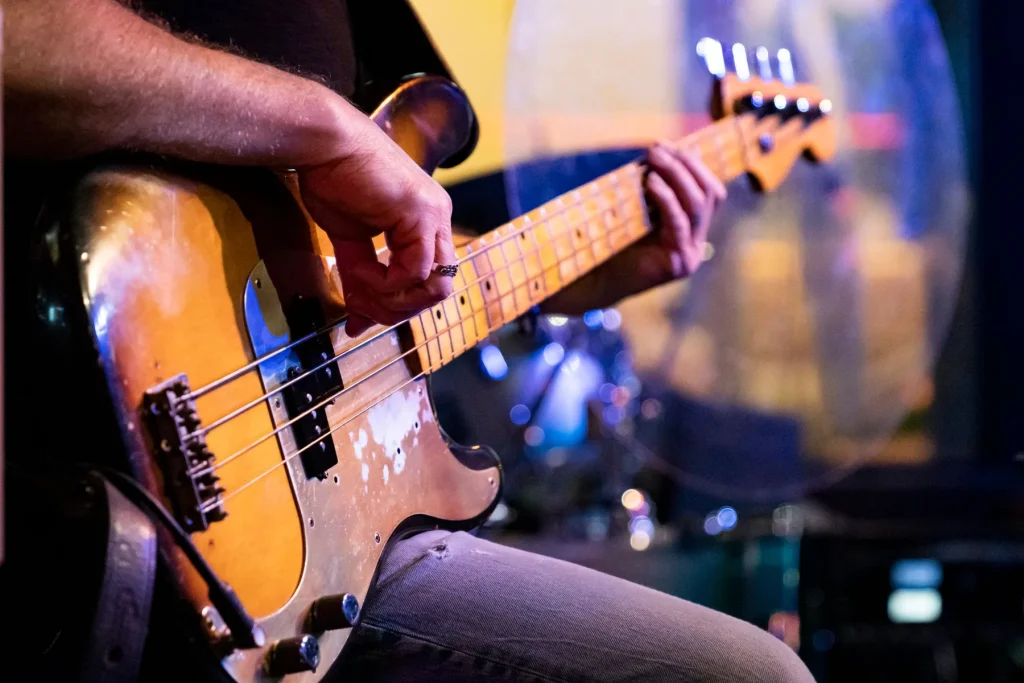
A practical warning: plugging a bass into a guitar amp is not without risk. The main concern is the speaker, rather than necessarily the electronics or tubes.
Low frequencies move more air and require greater cone movement. A speaker designed for guitar struggles with these mechanical demands.
At low volume and with the bass turned down, you may be able to play briefly without causing damage. Watch for warning signs: clipping, crackling, and excessive cabinet vibration.
Below, I’ll cover cautious settings, useful accessories (a preamp, line output, and dedicated cabinet), and ways to get by without causing major problems.
Why it’s risky: low frequencies, speakers, and the difference between guitar and bass amps
Reproducing low frequencies puts substantial mechanical strain on a speaker driver.
“IT’S THE SPEAKERS THAT ARE AT RISK!”
Speakers designed for guitars are optimized to reproduce the harmonics and tone of higher-pitched strings. Their frequency response and cone excursion (Xmax) are limited when faced with low frequencies.
The difference is clear in the numbers: a guitar covers roughly 82 to 1,197 Hz, while a bass goes down to around 41 Hz and reaches up to 987 Hz. This lower range calls for greater cone excursion.
The sonic result at low volume is a thin sound lacking body. Turn up the volume, and unwanted distortion, clipping, and cabinet vibration may appear.
According to players’ reports, the electronics often hold up, while the speaker driver takes most of the damage. In a band, turning up to be heard increases the risk.
- More low strings (a five-string bass or lower tunings) place a greater load on the speaker.
- If you try it, keeping the session short and the volume low is the best rule.
For technical advice on speaker power, see this article about power and speakers. For practical settings, consult this amp setup guide.
Plugging a bass into a guitar amp: risks and tips
Some amps quickly reveal their limits when low notes come through.
Clipping: you hear a harsh distortion, distinct from intentional overdrive. It signals that the speaker can no longer handle the frequency being sent to it.
Crackling: if the noise changes when you turn the knobs or move the plug, a poor connection (in the cable or jack) is often the cause, rather than the amp itself. Cleaning the contacts often solves the problem.

Cabinet vibration: a cabinet that shakes unusually or makes wooden rattling sounds indicates mechanical overload. In a band, turning up to cut through makes this worse and encourages distortion.
- A simple test: turn down the volume and bass, then raise them slowly until you notice abnormal behavior.
- Check the signal chain: make sure the cable, plug, and connectors are secure before blaming the electronics.
- If warning signs appear at home-listening volume, stop and use another setup.
For first-hand experiences and practical solutions, see this useful discussion on a technical forum.
Safer use: settings, volume, and accessories to limit damage
To reduce the risk, start at low volume with restrained EQ settings. First turn down the instrument’s volume, then set the amp’s master volume low. Raise it in small steps so you can detect any clipping or vibration.
Tone settings: turn the bass control almost all the way down. Raise it only enough to hear the fundamental note. Use the mids for presence, and soften the treble if the tone becomes too harsh.
Compressor: a compressor pedal smooths the signal and reduces peaks from slap playing or hard attacks. It can also make the low end seem fuller without forcing the speaker cone to move as far.
Passive or active bass: if the instrument is active, lower its volume and use an input with a dB pad or a “rhythm” setting if the amp has one. This helps protect the input stage and speaker.
Tubes or solid-state circuitry: neither mechanically protects the speaker. Tubes can color the sound, but the speaker driver remains the weak point. For moderate use, choose a combo with a 10- or 12-inch speaker over a very small model.
- Control volume in two stages: the instrument first, then the master volume.
- Use a compressor to smooth the signal and limit transients.
- If problems persist, switch to a line output or headphones.
| Use case | Suggested setting | Useful accessory | Note |
|---|---|---|---|
| Practicing at home | Low volume, reduced bass | Compressor or headphones | Put safety first |
| Band rehearsal | Avoid peaks; use cautious EQ settings | Line output or dedicated cabinet | Use a bass cabinet if possible |
| Slap or aggressive playing | Limit gain; use stronger compression | DI box or preamp | Small amps are best avoided |
Alternatives: when and how to do without a guitar amp
Instead of pushing a small speaker, consider sending the signal to equipment designed for low frequencies.
Headphones: a guitar amp’s headphone output works with a bass. It is the safest way to practice your timing without driving the speaker.

Line output: use the amp as a preamp. Send the signal to a PA speaker, a robust hi-fi system, or a subwoofer. At a reasonable level, these systems handle low frequencies better.
Suitable equipment: a proper bass amp and dedicated cabinet are built for the mechanical demands. If those are unavailable, a DI box or audio interface can help by sending the signal to an appropriate monitor.
- Take care with jack connections: use short cables and good-quality adapters to keep the signal clean.
- Raise the volume in steps and listen to how the downstream speaker responds.
- A practical example: preamp -> line output -> full-range speaker + subwoofer, with restrained EQ settings.
“There’s no problem using a guitar amp’s headphone output with a bass, or sending its line output to a suitable PA.”
Conclusion
As a temporary solution, using a guitar amp for bass calls for caution. Keep the volume low, reduce the bass, and raise the mids to help protect the speaker.
Watch for distortion, clipping, or vibration, and stop immediately if any appears. The difference in frequency and range explains why the speaker driver is more vulnerable than the electronics.
For lower-risk practice, use headphones, a line output into a suitable PA, or a proper bass amp and cabinet. A guitar combo may suffice at home, but dedicated equipment is preferable in a band for both durability and sound quality.