
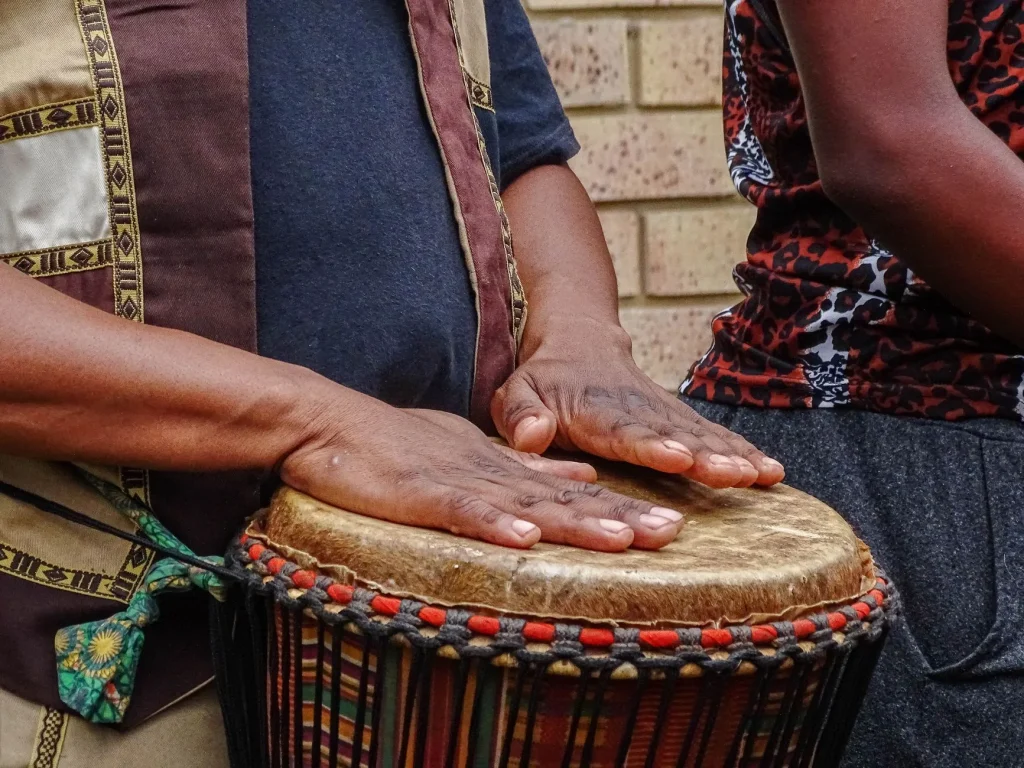
The djembe is far more than a simple drum. This percussion instrument embodies the cultural richness of West Africa. Its history stretches back more than 700 years to the Mandinka Empire in what is now Mali. The Mandinka, an ethnic group, played a key role in creating and passing on the instrument.
This drum accompanies all kinds of celebrations, from weddings to naming ceremonies. Its distinctive music has endured through the centuries, reflecting its importance in community life. In this article, we explore the djembe’s mysterious origins through both historical accounts and legends.
We also look at how its sounds carried it around the world. From its deep roots to its international popularity, the djembe’s journey is a fascinating one.
The geographical and historical origins of the djembe
This iconic drum has its roots in the heart of the Mandinka Empire, a flourishing kingdom established by Sundiata Keita in the 13th century. Located in West Africa, the empire covered a vast region that included Guinea, eastern Mali, northern Côte d’Ivoire and Burkina Faso.
The groups that adopted the instrument, including the Malinke, Wassoulounke, Soninke, Khassonke and Bambara of Kaarta, played a crucial role in its development. Living around present-day Mali, they enriched their region’s musical culture.
The Mandinka Empire and its founding peoples
The djembe is far more than an instrument; it reflects Mandinka cultural identity. The Mandinka Empire, known for its wealth and diversity, gave rise to many musical traditions. The drum became a symbol of unity and gathering.
A repurposed mortar and the earliest forms
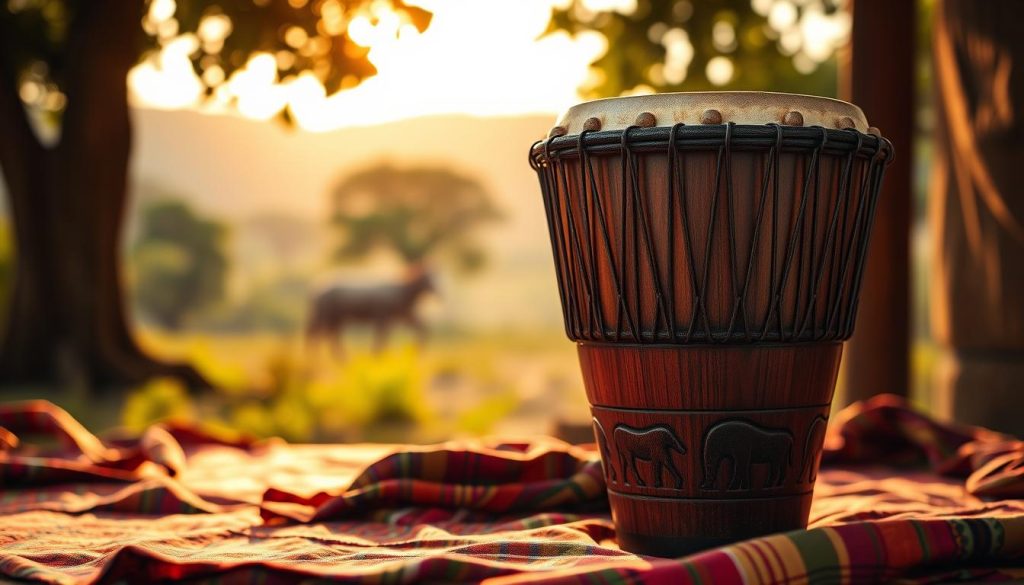
According to one account, the first djembe was a repurposed mortar, originally used to grind materials. By stretching an animal skin over the vessel, people created a new musical instrument. In this simple design, the mortar’s wood served as a resonating chamber.
The djembe’s earliest forms changed over time. Initially made without ropes or iron rings, its construction gradually became more complex.
The linguistic origins of the name “djembe”
One proposed origin of the word “djembe” is the Bambara expression “Anke dje, anke be,” meaning “everyone gather together.” This call evokes the importance of community. Another etymological theory connects the name to the Soninke word “dimmé,” meaning “drum.”
Oral tradition, essential to West African culture, has passed these accounts down through the centuries. With little written evidence, the djembe’s history blends accounts and legends, highlighting its central place in community life.
For more than 700 years, this instrument has played a fundamental role in ceremonies and traditional events. It also symbolizes a connection between wood, skin and metal.
| Element | Description |
|---|---|
| Region | Guinea, eastern Mali, northern Côte d’Ivoire, Burkina Faso |
| Peoples | Malinke, Wassoulounke, Soninke, Khassonke, Bambara |
| Materials | Mortar wood, animal skin |
| Name | Linked to the Bambara expression “Anke dje, anke be” |
To learn more about the history of this instrument, read this article.
West African peoples and their contributions to the djembe
In West Africa, several ethnic groups played an important part in the djembe’s development. Each brought skills that helped shape this iconic instrument.
The role of the Malinke and Bambara
The Malinke, for example, played an essential role in building the djembe’s body. They used a grain mortar to create its resonating chamber. This choice of material gave the drum a rich, deep sound.
The Bambara incorporated the djembe into their cultural and ceremonial practices. It became a powerful symbol of their identity and took a central place in celebrations and rituals.
Contributions of the Soninke, Wassoulounke and Khassonke
The Soninke also contributed to the djembe’s development by introducing goatskin for the drumhead. This innovation improved the instrument’s sound.
The Wassoulounke refined the drum’s sound by adding tensioning ropes. Their craft gave the djembe greater resonance and clarity.
Finally, the Khassonke developed specific striking techniques. These produced a wider variety of sounds and made the instrument more versatile.
Collaboration among these groups enriched djembe making and strengthened cultural ties within the Mandinka Empire. Each contributed to an instrument capable of accompanying many different rhythms.
These contributions, dating back centuries, reflect the region’s cultural richness. As a percussion instrument, the djembe has become an emblem of West Africa.
Legends and myths about the djembe’s origins
The stories surrounding this instrument are as varied as the cultures that shaped it. Each legend adds a dimension to the djembe’s history and meaning within communities. These stories reveal aspects of tradition and identity.
The legend of the pierced mortar and goatskin
One popular legend tells of a village woman who had the idea of making a hole in the bottom of a mortar. Her husband, standing nearby with a goatskin, inspired her. She stretched the skin over the mortar, creating the first djembe. The story symbolizes human creativity and ingenuity, showing how everyday objects can become musical instruments.
Bambara mythology and the “gebraffe” djembe
In Bambara mythology, the djembe was supposedly made from the skin of a creature called the “gebraffe,” part giraffe and part zebra. This legendary creature embodies harmony among elements of nature. The story underscores the instrument’s importance in musical culture and symbolizes a connection between people and animals.
The story of So Dyeu and the chimpanzees
Another story, preserved by ethnomusicologist Hugo Zemp, tells of a trapper named So Dyeu. He watched chimpanzees playing a drum in the trees. Intrigued, he set a trap to capture the instrument. After catching a young chimpanzee, he was rewarded by the village chief, who offered him his eldest daughter in marriage. Since then, the story says, chimpanzees have beaten their chests instead, leaving the djembe to humans.
These colorful accounts form a complex body of oral tradition. They continue to captivate listeners and remind us that even experts do not claim to know the absolute truth about the instrument’s origins. Each story adds a touch of magic to the djembe’s history, which continues to fascinate people around the world.
| Legend | Summary |
|---|---|
| Pierced mortar and goatskin | A woman creates the first djembe by stretching a skin over a mortar with a hole in it. |
| Bambara mythology | The djembe is said to have been made from the skin of a hybrid creature called the “gebraffe.” |
| So Dyeu the trapper | So Dyeu captures a drum played by chimpanzees and receives an unexpected reward. |
For a deeper look at the history of this instrument, read this article.
Traditional construction and spiritual symbolism
Making a djembe is a craft that reflects harmony between people and nature. Blacksmiths play a central role in creating the instrument. Each drum is made for its percussionist, forming a connection between maker and player.
The blacksmith’s work and the lengue ritual
Before beginning, blacksmiths perform a sacred ritual called lengue. This traditional offering seeks the spirits’ permission before a tree is cut down to make a djembe. The act reflects respect for nature and the spiritual beliefs surrounding the instrument.
The spirits associated with the djembe: tree, skin, blacksmith and ancestors
According to legend, the drum contains three essential spirits: that of the tree from which it was made, that of the animal whose skin was used, and that of the blacksmith who assembled it. The spirit of the ancestors is also said to hold a prominent place.
Traditional materials: solid wood, goatskin, ropes and rings
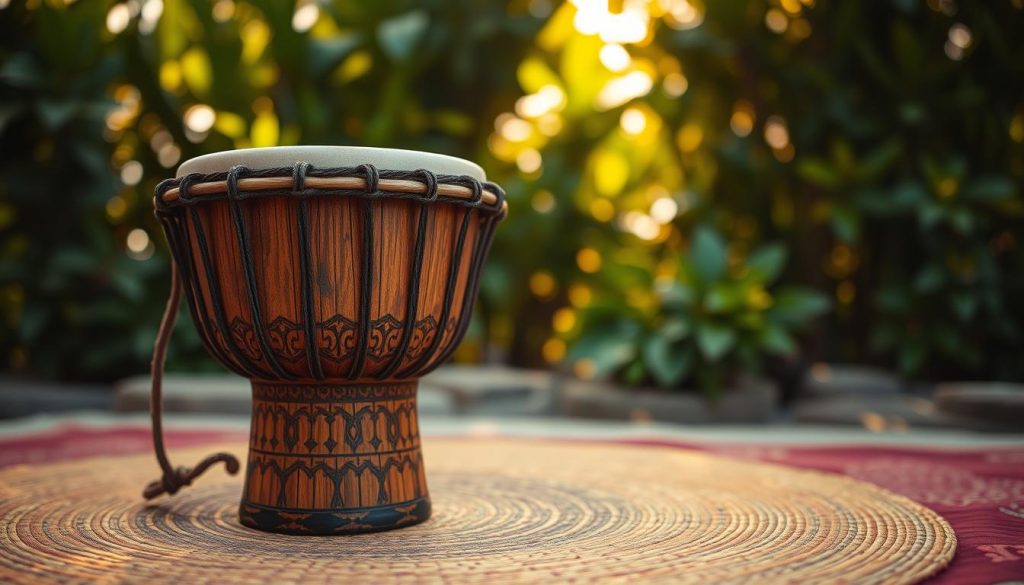
The materials used in construction are essential to the djembe’s quality. Solid wood forms its body, while a stretched goatskin forms the drumhead. Ropes and iron rings provide the tension needed to produce a rich, deep sound.
Each part of the djembe carries spiritual meaning. Wood represents plant life, skin the animal world, and iron rings the mineral world. Together, these materials express a connection among fundamental elements of the universe in African cosmology.
The African djembe: origins, history and traditions in the modern era
Since its beginnings, this percussion instrument has undergone many changes. Construction evolved from a skin stretched over a shell to sturdier structures incorporating iron rings and ropes. These improvements increased the drum’s durability and expanded its range of sounds.
The tone of traditional djembes, known for bright and delicate sounds, changed with industrial production. Modern factory-made versions offer deeper tones, giving percussionists more musical possibilities.
The instrument began gaining worldwide popularity in the 1950s. Fodéba Keïta, an influential musician from Guinea, played a key role in that spread. Through Les Ballets Africains, supported by Guinean president Sékou Touré, the djembe reached the international stage.
Les Ballets Africains introduced the instrument to audiences in Europe and North America. This exposure brought the djembe wider recognition in the music world.
In the 1980s, master djembefolas such as Famoudou Konaté, Adama Dramé, Amadou Kiénou and François Dembélé helped establish its international reputation. Mamady Keïta also championed the instrument, sharing his expertise around the world.
International djembe schools have passed traditional techniques on to musicians from many backgrounds. These institutions play an important role in preserving cultural heritage and teaching African rhythms.
More recently, countries such as Japan and China have shown growing interest in the djembe and traditional dances. That enthusiasm reflects the instrument’s lasting impact on the global music scene.
Percussionists continue to share their passion for the djembe as ambassadors of African music. Their commitment strengthens cultural ties and promotes this music’s richness.
Over time, the djembe has grown from a local instrument into a symbol of music around the world, through decades of passion and innovation.
| Key points | Details |
|---|---|
| Changes in construction | From a stretched skin to iron rings and ropes |
| Impact of industrial production | Introduction of deeper tones |
| Growing popularity | The 1950s, through Fodéba Keïta and Les Ballets Africains |
| Master djembefolas | Famoudou Konaté, Adama Dramé, Mamady Keïta |
| International schools | Passing on traditional techniques |
| Worldwide interest | Growing enthusiasm in Japan and China |
To explore the instrument’s history and cultural meaning further, read this article.
Djembe striking techniques and its range of sounds
Percussionists called djembefolas use a range of techniques to produce varied sounds. These techniques help express the emotions and rhythms that bring the instrument to life. Here are the main strokes behind the djembe’s sound.
The main strokes: tone, slap, bass and pop
The four fundamental strokes are tone, slap, bass and pop. Each produces a distinct sound and adds to the music’s complexity.
- Tone: this technique strikes the middle of the skin with the fingers together. It produces a clear, powerful, melodic sound.
- Slap: striking with the palm and allowing it to rebound produces a sharp, high sound that adds energy.
- Bass: this stroke uses the palm at the edge of the skin to produce a low, deep, resonant sound.
- Pop: a quick finger stroke produces a short, lively sound suited to rhythmic effects.
Rhythmic combinations and variations
Percussionists can explore countless combinations and rhythmic variations by alternating these strokes. By combining sounds, they create complex patterns that enrich the music. Mastering the techniques gives players considerable freedom of expression.
How the skin and shell produce sound
The djembe’s sound depends heavily on the tension of its goatskin. A well-tensioned skin produces clearer, more powerful sounds. The size and shape of its solid wooden resonating chamber also affect the instrument’s projection and tone.
Every part of the djembe helps create its distinctive sound. Experienced musicians use these qualities to express a wide range of emotions through their playing.
Examples of traditional djembe rhythms
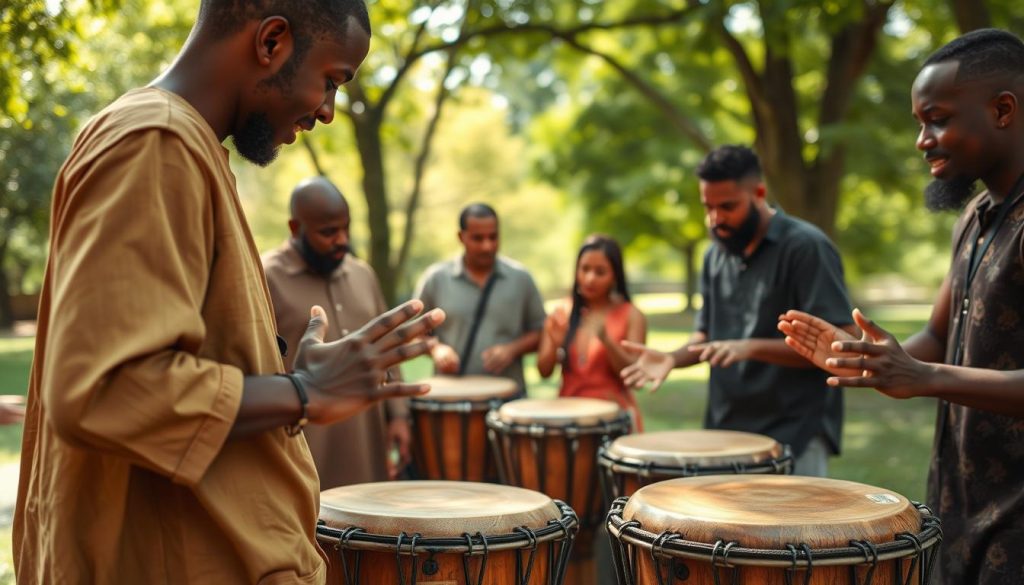
Djembe music is an essential part of rituals and celebrations in West Africa. Each rhythm played on the instrument tells a story and connects generations. Here are some rhythms that illustrate this musical culture’s richness.
Djembe Mendiani, a wedding rhythm
Djembe Mendiani is a traditional Mandinka rhythm played at weddings. It celebrates the couple’s union and creates a joyful, festive atmosphere. Guests dance and sing, strengthening community bonds.
Dundunba and initiation ceremonies
Dundunba is a powerful, solemn rhythm performed at initiation ceremonies and major community celebrations. Its deep sounds accompany significant rites of passage and symbolize the transition to adulthood. It plays a central role in passing on cultural values.
Kuku and other festive rhythms
Kuku is an energetic, playful rhythm often played at village festivities. It brings the community together in dance and creates an atmosphere of joy and sharing. It expresses the spirit of togetherness associated with celebrations.
Funeral and contemplative rhythms: Tiriba and its variations
Funeral rhythms such as Tiriba accompany the dead at funerals. Originating in Guinea, this rhythm brings a contemplative quality and allows loved ones to mourn. Regional variations show how each ethnic group brings its own approach to djembe playing.
Griots and master djembefolas pass these traditional African rhythms on orally from one generation to the next. Music and drumming help communities communicate and express emotion. The djembe’s varied rhythms accompany life’s moments, from birth to death.
These rhythms have traveled around the world and are now taught in international African percussion schools. Preserving them means protecting treasures of African musical heritage.
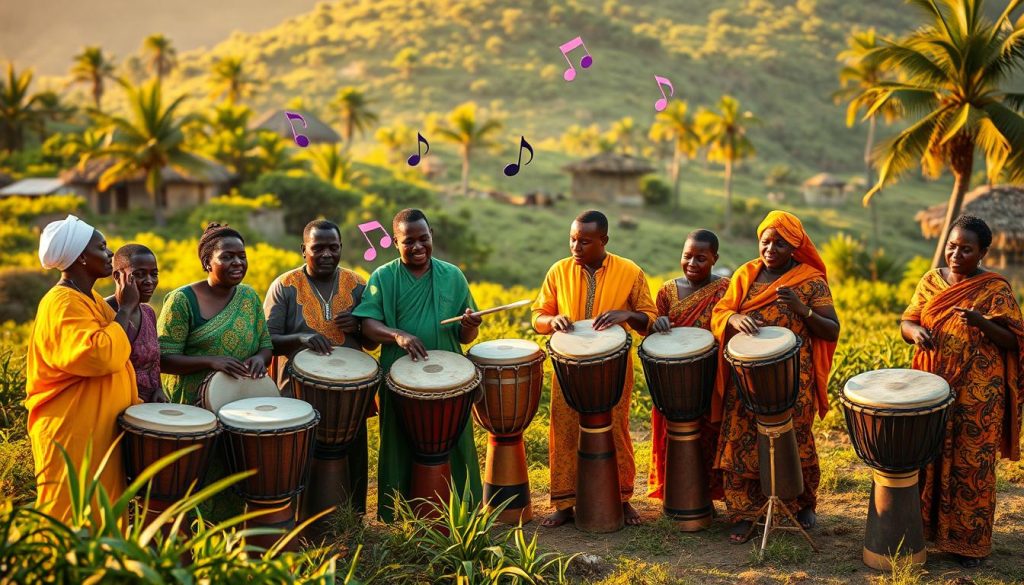
The djembe’s cultural and social role in West Africa
At the heart of West African culture, the djembe is much more than a drum. It plays an essential role in communication and communal expression. This iconic instrument accompanies important moments in life and brings people together through music and rhythm.
An instrument of communication and communal expression
The djembe conveys emotions and messages through sound. At gatherings, it connects people and strengthens their sense of belonging. The Bambara expression “Anke dje, anke be,” meaning “everyone gather together,” captures this role.
Its place in traditional ceremonies: weddings, naming ceremonies and funerals
The djembe holds a central place in traditional ceremonies. At weddings, naming ceremonies and funerals, it accompanies rites of passage. Each event has its own rhythms, adding a spiritual or festive dimension. The drum thus bears witness to life’s joys and sorrows.
Griots and the oral transmission of stories
Percussionists, often associated with the griot or jeli tradition, are guardians of cultural memory. They preserve their people’s oral history through music. According to tradition, djembe playing was once reserved for those born into griot families. Today, griots continue to pass on stories, legends and genealogies, with the djembe accompanying their performances.
The drum also symbolizes balance in the world. Wood represents plant life, skin the animal world, and iron rings the mineral world. Together, these elements illustrate harmony in the universe.
The djembe is a pillar of cultural and social identity for West African peoples. For centuries, it has shaped everyday life and strengthened community ties. Its role in ceremonies and rituals makes it an invaluable witness to the richness of African traditions.
| Elements | Description |
|---|---|
| Role | An instrument of communication and communal expression |
| Ceremonies | Accompanies weddings, naming ceremonies and funerals |
| Griots | Guardians of tradition and oral history |
| Symbolism | Balance among wood, skin and iron |
To learn more about the djembe’s cultural importance, read this article.
The djembe’s international expansion and musical influence
The djembe’s rise on the international music scene has been remarkable, especially since the 2000s. This longstanding instrument has won over musicians far beyond its West African roots. Its use in different genres has opened the way to new combinations of styles.
World music and the blending of styles
The djembe has found a place in many contemporary styles. Genres such as pop-rock and Afro-rock have incorporated its sounds. This blending brings traditional and modern music together.
Its impact on pop-rock, Afro-rock and contemporary music
Renowned percussionists such as Noel “Toca” Rivera have played a key role. Working with international artists including Jason Mraz, they brought the djembe into pop-rock arrangements. These collaborations helped popularize the instrument in contemporary music.
Notable percussionists and collaborations
Artists around the world have embraced the djembe at festivals and concerts. Japan, for example, is among the countries where enthusiasm for the instrument has grown more recently. Interest has also expanded in China.
The djembe has adapted to modern musical settings while retaining its distinctive sound. For professional musicians, construction quality remains essential to getting the best from the instrument.
From a traditional drum, it has become an ambassador of African culture. Its sounds now resonate on stages worldwide, showing its lasting musical influence.
| Key points | Details |
|---|---|
| International expansion | Growing presence on the global music scene since the 2000s |
| Influenced genres | Pop-rock, Afro-rock, contemporary music |
| Notable artists | Noel “Toca” Rivera, Jason Mraz |
| Countries with growing interest | Japan, China |
| Importance of quality | Essential for professional musicians |
How can you choose and buy a quality djembe today?
Finding a quality drum starts with understanding its materials and construction. Choosing a good instrument can transform your playing experience. Here are a few points to guide you.
Materials and construction: essential criteria
To get an excellent sound, pay attention to the materials. First, the instrument’s body should be made from solid wood. This supports resonance and durability.
A goatskin drumhead is also important. It directly affects the sounds the drum produces. Tensioning ropes and iron rings contribute to the instrument’s strength and tuning.
The drawbacks of industrial models and recommended shops
Be careful with industrial models. Those made from poor materials often have a disappointing sound. Specialist shops such as Instruments du Monde offer djembes made with respect for longstanding traditions.
Such models are less common and made with close attention to detail, so each drum sounds as it should.
Advice for beginners and instrument care
Beginners should choose a drum that suits their size. Learning basic hand striking techniques helps you progress at your own pace.
Care matters too. Protect the djembe’s goatskin and wood to extend its life.
The differences between a handmade and an industrial drum can be heard and seen in their shape, construction and sound. A good djembe can accompany a musician for many years.
| What to check | Description |
|---|---|
| Materials | Solid wood for the body, goatskin for the drumhead |
| Ropes and rings | Provide strength and help keep the drum in tune |
| Industrial models | Often lower quality, with a disappointing sound |
| Recommended shops | Instruments du Monde, with respect for tradition |
To learn more about choosing a good drum, read this article.
Conclusion
This iconic West African drum has deep roots in the region’s cultures. It embodies community communication and expression. Over the centuries, it has evolved, enriching rhythms and sounds heard around the world today.
Its striking techniques, materials such as wood and skin, and the legends surrounding it show its importance in people’s lives. The djembe plays a central role in ceremonies and brings people together through music and dance.
This instrument is a treasure of cultural heritage. It continues to bring people together through music and tradition. To learn more about it, read this article.