

Learning the djembe has become more accessible thanks to the many resources available online. Video tutorials, specialist platforms and percussion communities let you learn at your own pace. You can make progress without investing in expensive lessons.
This guide is for beginners, players returning to the instrument and musicians who want to give their learning more structure. With resources available around the clock, you can practise whenever it suits you, whether just before a meeting or in the evening.
We will explore different ways to learn, how to choose the right instrument and how to build an effective practice routine. We will also share practical advice for playing without disturbing your neighbours, an important consideration for percussionists in urban areas.
Along the way, you will discover how to combine free tutorials with live online lessons to stay motivated and improve. Our aim is to help you enjoy playing and master this fascinating instrument.
1. Choose the right djembe for comfortable, effective learning
Choosing a suitable instrument is essential for an enjoyable learning experience. A good drum affects both playing comfort and sound quality. Both have a direct effect on a musician’s motivation and progress.
Essential criteria: size, material and sound quality
For an adult, a diameter of 30 to 35 cm is recommended. A drum that is too large can make slaps awkward, while one that is too small limits sound projection. Children need a smaller djembe that they can handle comfortably.
As for materials, solid wood, such as teak, lenke or djalla, offers a warm, traditional resonance, but is heavier. Synthetic models are lighter, weather-resistant and easier to carry.
Sound quality is crucial. A well-tensioned head and a well-made shell produce clear, distinct sounds. Beginners can then hear their mistakes and correct their hand technique more quickly, speeding up learning.
Essential accessories to protect the instrument and make playing easier
Suitable accessories are also important. A djembe stand or adjustable tripod holds the instrument in place while you play. A padded carrying case protects the drum from moisture and knocks. Consider keeping a replacement head on hand in case the original wears out.
A quality instrument helps you distinguish the three fundamental strokes: bass, tone and slap. This sharpens your ear and makes playing more enjoyable. “A quality instrument is the foundation of successful learning.”
Djembes handmade by experienced African percussionists offer an authentic musical experience. Ultimately, choose a djembe for its playing comfort and sound quality as well as its price and appearance.
2. Different ways to learn the djembe
To improve your djembe playing, choose an approach that suits the way you learn. The three main options are in-person lessons with a teacher, online resources and self-directed learning. Each has advantages and limitations depending on the learner.
In-person lessons with a teacher: advantages and limitations
Learning with a teacher in person is an excellent way to master the instrument. Local music schools and cultural centres often offer djembe lessons. A teacher can correct your posture and strokes immediately while guiding you through a personalised programme.
However, this approach has limitations. The average cost is around €31 per hour, which may be too much for some learners. The availability of specialist teachers also varies by region. Finding a regular time that fits a busy schedule can be difficult.
To find a teacher, explore these options:
- Local music schools
- Conservatories
- Community centres
- Social media
- Music events
Explore video tutorials and online lessons: flexibility and independence
Video tutorials on platforms such as YouTube are especially useful for beginners. They cover the basics, from positioning the instrument to striking techniques. Online lessons let you learn at your own pace and offer considerable flexibility.
The advantages of online lessons include:
- Access around the clock
- The ability to revisit lessons
- Lower costs, with subscriptions starting at €5.90 per month
- Contact with the instructor for personalised feedback
Self-directed learning: resources, communities and self-assessment
The internet makes self-directed learning accessible to everyone. By combining free tutorials, specialist articles and percussion forums, you can progress independently. This approach also helps develop your ear and your ability to assess your own playing.
Online communities provide valuable places to exchange ideas. You can share recordings, receive constructive feedback and collaborate with other musicians remotely. This approach does, however, require considerable personal discipline and motivation.
A combined approach is often useful. Online lessons can give your practice structure, free tutorials can add variety to your exercises, and occasional live online sessions with a teacher can provide individual guidance.
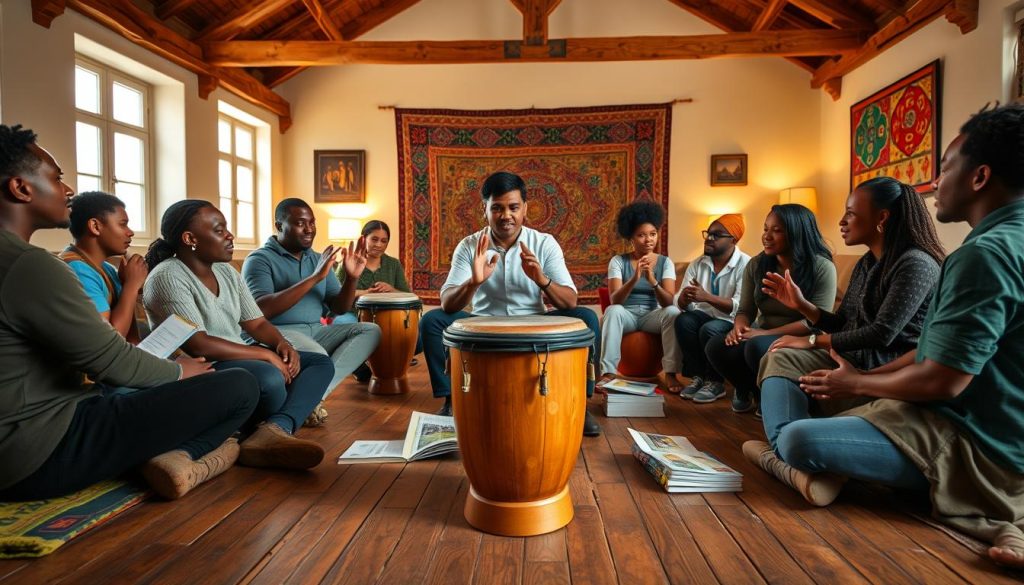
3. Online djembe lessons: how can you improve at home?
Learning a musical instrument has taken on a new dimension. Digital resources now make it possible to begin learning percussion at your own pace. Online lessons offer flexibility and allow musicians at every level to practise whenever they wish.
Choose a learning path suited to your level and goals
To get the most from your learning, choose a path that matches your skills and ambitions. Beginners should favour structured programmes with clear stages of progression. One effective method is to practise at three speeds: slow, normal and then fast. This helps build muscle memory.
“Playing cleanly at a slow speed helps you maintain a steady rhythm later.”
Comprehensive programmes often offer more than 180 videos and 12 classic rhythms. They let you explore different techniques and broaden your musical experience.
Organise your practice with a regular, structured routine
Regular practice is the key to improvement. Even 15 minutes a day can be enough if you follow a coherent programme. Alternate between warming up, technical exercises, working on a rhythm and playing with a metronome. This structure will help you develop your technique.
To give your learning more structure, you could choose a paid programme whose modules become available gradually. Here are some indicative prices:
| Duration | Price |
|---|---|
| 1 month | €9.90 |
| 3 months | €7.90 |
| 6 months | €5.90 |
Use digital tools: metronomes, recordings and backing tracks
Digital tools can support your learning. A metronome built into an online lesson platform helps you keep a steady tempo. Audio and video recordings let you assess your playing and measure your progress. They also help you spot mistakes and refine your technique.
Backing tracks let you play alongside other instrumental parts and enrich your musical experience. Vary the resources you use to maintain your motivation. In addition, 97% of teachers offer a free first lesson by video call, allowing you to see whether their teaching style suits you before you commit.
Ultimately, progress depends on regular practice and thoughtful use of digital resources. With a good programme and a structured approach, each practice session can become both effective and enjoyable.
4. Build an effective practice programme to improve quickly
To master an instrument such as the djembe, you need a well-structured practice programme. Consistency and clear goals are the foundations of rapid progress.
The importance of consistency and clear goals
The key to improvement is regular practice. Spending 15 to 30 minutes a day on the djembe is preferable to one long, intensive session each week. Daily repetition of movements builds muscle memory.
Setting clear, measurable goals matters just as much. For example, you might aim to learn a particular rhythm, increase your playing speed or sustain a clean pattern for 2 minutes at 80 bpm. Goals like these will help structure your practice programme.
Warm-up exercises and developing muscle memory
Warming up before each session helps prevent injury. Recommended exercises include:
- Slow wrist rotations
- Opening and closing your hands
- Very light strokes on the drumhead to prepare your joints
These exercises prepare your hands without overworking them and can improve the quality of your playing. To develop muscle memory, practise each stroke separately for 3 minutes at a slow tempo. Alternate between your right and left hands, then reduce the force of your strokes before increasing the speed.
Gradual progression: from simple to complex, from basic rhythms to polyrhythms
Begin with simple rhythms such as Kuku in 4/4 time. Master the pulse and fundamental strokes before adding variations, breaks and accents. Once you are comfortable with these basics, you can explore more complex polyrhythms, which layer several patterns.
It is also important to alternate coordination exercises and explore different rhythms and musical styles. This keeps your practice varied and broadens your experience. Include backing tracks to simulate playing with a group.
Increase the tempo in steps of 5 bpm, but only when the sound stays clear for 1 to 2 minutes. This will help you build a solid technical foundation and avoid developing bad habits.
Listening closely to accomplished musicians such as Mamady Keita can also enrich your learning. Marking the pulse, singing the strokes and then turning what you hear into metronome exercises is an excellent way to improve your playing.
“Consistency and good technique bring better results than long sessions spaced far apart.”
A well-designed practice programme that combines warm-ups, technique, rhythm and backing tracks can help you make lasting progress on the djembe.
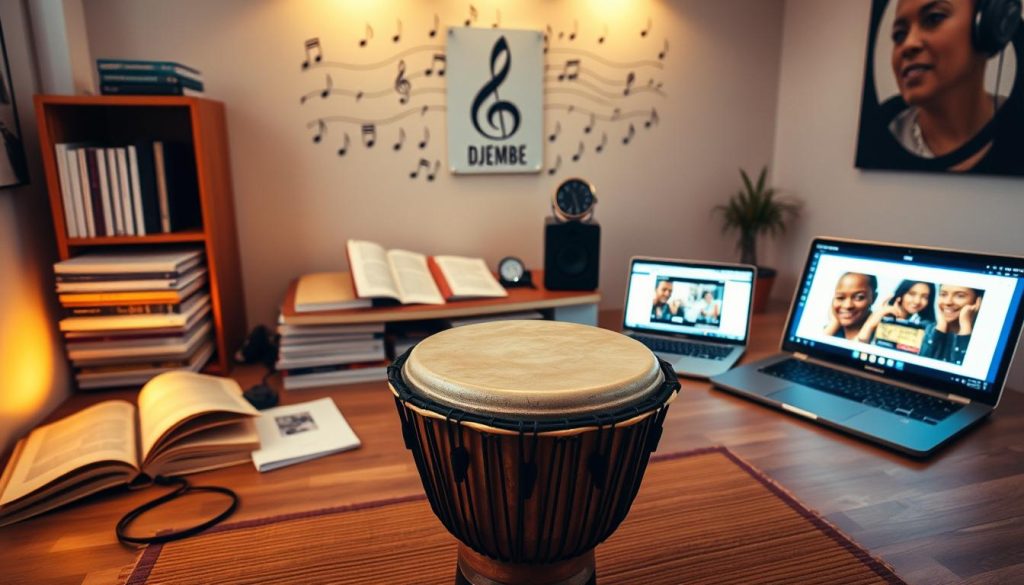
5. Discover and master African rhythms to enrich your playing
African rhythms are rich and varied, and lie at the heart of the continent’s musical cultures. Each region and ethnic group has developed its own musical traditions, deeply rooted in community history and spirituality.
The history and diversity of traditional rhythms
Djembe playing styles vary considerably. For example, the powerful, fast rhythms of Mandingue musicians in Guinea contrast with the fluidity of Malian rhythms. The complexity of Ivorian polyrhythms offers another distinctive musical experience.
Each rhythm tells a story, conveys emotion and connects people to their roots. These traditional rhythms accompany ceremonies and celebrations, adding to their cultural importance.
Learn and sing patterns before playing them
To master these rhythms, start by listening closely to recordings of master percussionists such as Mamady Keita. Singing patterns before playing them strengthens rhythmic memory.
Try reproducing the patterns slowly on the djembe while keeping a steady pulse. This approach helps you understand the rhythms more deeply.
Playing in a group: the importance of listening and synchronisation
Group playing is an important part of improving. Playing with other musicians encourages careful listening and helps stabilise the tempo. It speeds up your grasp of rhythms and lets you share knowledge.
Joining local workshops or online groups can enrich your practice. Even at a distance, exchanging recordings with other musicians helps develop synchronisation.
A motivating goal is to build a small repertoire of 3 to 5 traditional rhythms to play in a group, such as Kuku, Djolé or Suku. This can give you an authentic and rewarding musical experience.
Discovering African rhythms is both a musical and a cultural journey. It introduces you to new sounds, enriches your playing and connects you with a centuries-old tradition.
6. Measure your progress in learning the djembe
Assessing your progress regularly helps maintain motivation and shows whether you are moving in the right direction. This is especially useful for independent learners: without a teacher, self-assessment becomes a skill to develop.
Regular self-assessment through audio and video recordings
Recording your sessions is a valuable way to assess your playing. Record 30 to 60 seconds of the same exercise each week. You can then compare the files and check your progress in:
- Tempo
- Stroke accuracy
- Sound quality
Use a simple checklist to analyse your recordings. Check how consistently you play with the metronome, the clarity of the three fundamental strokes (bass, tone and slap), the quality of the sound and how relaxed your body appears in the video.
Set measurable goals and record your achievements
Clear, achievable goals help structure your progress. For example:
- Maintain a clean pattern for 2 minutes at 80 bpm
- Play 3 patterns in succession without losing the pulse
- Produce a clear slap 8 times out of 10
Keeping a practice journal is also helpful. Note your total practice time, the tempo you worked on, a difficulty you encountered and one small success from the day. This written record will help you see your progress over time and stay engaged with your practice programme.
Use feedback from the community and online teachers
Feedback from communities and online teachers can complement your self-assessment. Share recordings on forums such as DjembePlayer.org or in Facebook groups dedicated to the djembe. Ask for specific feedback on your sound, timing and posture, then apply the advice to improve more quickly.
Live online lessons with a teacher can provide targeted corrections. A free first trial lesson lets you see whether the teacher’s approach suits you and receive personalised feedback on your posture, where your hands strike the head and the clarity of your sounds.
Musical exploration is another exciting part of learning. It is important, however, to balance personal creativity with a command of the basics. Dedicated self-taught percussionists spend time on traditional rhythms to build strong foundations.
Learning the djembe is a personal journey without a fixed timetable. Each percussionist develops at their own pace, aiming to find their own musical voice through regular self-assessment and constructive feedback.
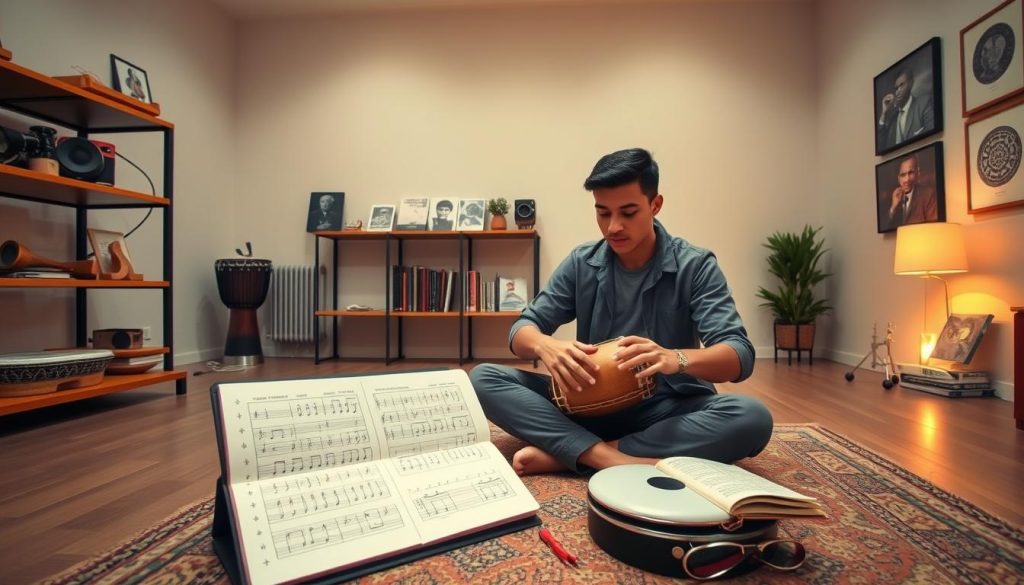
7. Practise the djembe at home without disturbing your neighbours
It is important to practise without disturbing those around you. Playing a percussion instrument can quickly become a challenge, especially in an urban setting. Fortunately, simple techniques can help you play more quietly.
Sound-dampening techniques and acoustic accessories
One effective method is to dampen the sound. Placing a cloth or small sponge inside the resonating chamber can considerably reduce the volume. Try different materials and positions to find a balance that works for you. This can preserve a satisfying playing feel while softening the sound.
For a simple setup, place a thick rug beneath the drum to absorb vibrations transmitted through the floor. Add sound-absorbing panels or cushions around your practice area. An anti-vibration support beneath the shell can also reduce vibrations reaching neighbours below.
Choose practice times that work for everyone
Choosing suitable practice hours matters too. Avoid playing late at night or early in the morning. Favour times when noise is generally better tolerated, such as early afternoon. Plan short, regular sessions and agree on reasonable hours with those around you.
Alternatives: electronic djembes and quiet practice pads
If you need a quieter option, consider a practice pad. It lets you work on coordination and alternate strokes between your right and left hands with little noise. An electronic djembe used with headphones offers a quiet option while providing good sound for the player.
A combined approach can also work well. Practise technique and coordination on a pad or electronic djembe, then use the acoustic instrument at acceptable times. You can also practise outdoors in open spaces such as parks or gardens, where the natural acoustics may suit your playing.
Finally, communicate with your neighbours. Explain your interest in drumming and let them know your usual practice hours. Straightforward communication can help prevent conflict and maintain good relationships.
With a little organisation, creativity and mutual respect, you can practise the djembe at home without disturbing your neighbours. These adjustments may also help you develop more precise, controlled playing.
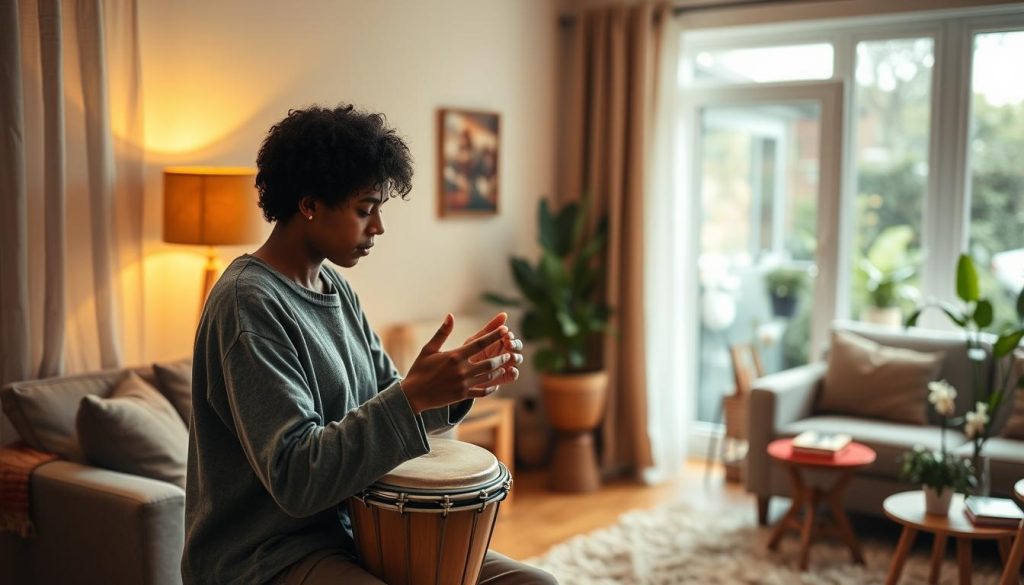
8. The importance of a good instrument and quality guidance
To reach a satisfying level on the djembe, it helps to have a quality instrument and suitable guidance. Even Africa’s greatest djembefolas spend years refining their playing. A good instrument and strong teaching support can make a significant difference to your progress.
How a suitable, well-tuned djembe supports motivation
A quality djembe produces clear, distinct sounds. That makes playing more enjoyable and helps you hear your progress. Conversely, a low-quality instrument with a harsh sound can discourage even enthusiastic players. Good tuning is also essential: clear resonance and a responsive head make it easier to learn the three fundamental strokes.
The value of serious, progressive training
Structured programmes that ask you to practise at three speeds (slow, normal and fast) strengthen muscle memory. They help you avoid bad habits and progress consistently. Comprehensive courses often offer more than 180 videos, 12 classic rhythms, downloadable PDFs, backing tracks and a built-in metronome. Together, these resources support structured independent learning.
Where to find reliable instruments and respected learning resources
The Instruments du Monde online store offers a selection of quality djembes for an enjoyable musical experience. Practical guides and beginner learning paths can help you deepen your understanding of early rhythms and techniques. When choosing an online course, favour platforms with videos filmed from several angles, demonstrations with a metronome and an active community.
Guidance from a teacher, even occasionally over a video call, can make a real difference. A teacher can correct your posture, where your hands strike the head and the clarity of your sounds. In addition, 97% of teachers offer a free first trial lesson, so you can see whether their teaching style suits you without committing.
Investing in a good djembe and quality training is a sensible choice. It can speed up progress, strengthen motivation and make learning more enjoyable over time. The quality of your instrument and guidance directly affects your playing and the pleasure you take in it.
9. Conclusion
To learn to play the drum, combine varied resources with regular practice. Choose a quality instrument suited to your size and adopt a structured practice routine.
Remember that progress rests on three things: precise technique, a steady tempo and thoughtful repetition. Set an achievable tempo goal and devote 15 to 30 minutes a day to practising for one week.
Make use of the many available resources, including free YouTube tutorials and specialist platforms. Joining percussion communities can also help you stay motivated.
Finally, explore traditional African rhythms to enrich your playing and connect with a centuries-old musical tradition. With consistency and curiosity, learning can become a joyful, lasting experience.
To begin your musical journey, browse the djembes available from Instruments du Monde and choose a quality model to support your progress.