

The secondhand market offers an opportunity for percussionists who want a quality instrument without spending a fortune. It also carries risks, including buying a poorly maintained drum or one with a fragile head. This guide is for everyone, from beginners to experienced musicians looking to expand their collections.
To make a good purchase, you need a thorough method. This guide provides a ten-point checklist: wood, base, head, ropes, sound, origin, price, seller, negotiation, and maintenance. A good instrument should be sturdy, tunable, and capable of producing clear sounds in all three fundamental registers.
Before making your decision, inspect the instrument carefully. This will help you avoid unpleasant surprises and buy with confidence. We will also cover where to shop and the factors to consider when making an informed choice.
Why choose a used djembe instead of a new one?
Buying a secondhand drum has many advantages. With the same budget, you can often get a model made from better wood or with a finer finish. Handcrafted instruments made from prized woods such as lenke or mahogany may cost a fraction of the price of a new model.
For example, a handcrafted Malian drum that costs €300 to €500 new may sell for around €80 to €180 used, depending on its condition. That value is hard to beat.
Another advantage is natural break-in. Over time, the wood fibers settle and the goatskin reaches a stable tension. The sound becomes more consistent and predictable than that of an instrument that has yet to be played in.
“An instrument played for several years has developed a unique sonic character, making it especially rewarding to play.”
Choosing a used drum is also an environmentally responsible decision. It reduces the carbon footprint of your purchase and helps conserve African forest resources, which face growing demand.
Still, you need to be careful. A badly worn head or ropes that need replacing can wipe out your savings. A thorough inspection is essential.
The secondhand market can also turn up traditional djembes made using long-established methods and imported 15 to 20 years ago. These instruments may offer craftsmanship that is becoming harder to find in new models.
In short, buying a used drum can be a wise choice if you check its condition and test its sound before completing the purchase.
| Instrument type | New price (€) | Used price (€) |
|---|---|---|
| Handcrafted Malian drum | 300 to 500 | 80 to 180 |
| Mahogany djembe | 250 to 400 | 70 to 150 |
| Lenke djembe | 300 to 450 | 90 to 160 |
Define your needs before buying: use, size, and transport
Before you start looking, decide what you need. This will help you choose the instrument best suited to your playing style.
Intended use: beginner practice, regular playing, or performance
Be clear about how you plan to use the drum. Learning the basics, practicing at home, playing with a group, and performing onstage can each call for a different instrument.
- For a beginner, the instrument should be easy to hold and tune, making it easier to progress.
- For regular playing, prioritize comfort and stability, especially during long sessions.
- If you plan to perform onstage, look for a model with power and good sound projection.
Why size and ergonomics matter
Drum size directly affects comfort, volume, and hand fatigue. A larger model generally offers deeper bass and greater projection.
For an adult, a diameter of 12 or 13 inches is often recommended. Your hands should cover about one-third of the head, with your fingers angled like the sides of a pie slice.
- Senegalese models made from dense wood are heavier and are better suited to seated playing.
- Lighter Guinean or Malinke djembes are ideal for playing while standing with a strap.
Transport and storage
If you travel with your instrument, consider its size and weight. A properly fitted protective case is essential for transport.
Try the drum while seated and while standing with a strap to assess its comfort. Check that it does not rub uncomfortably against your calves or waist.
Remember that size and weight directly affect how much you enjoy playing and how regularly you practice over time.
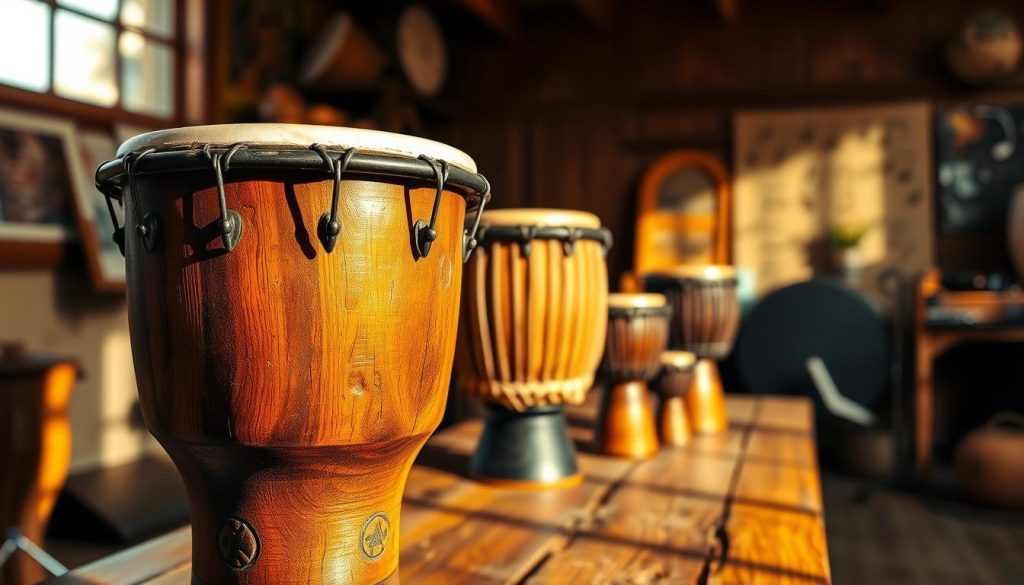
Where can you buy a used djembe in France?
To find a quality instrument, it helps to know the different places you can buy one. Each has advantages and drawbacks to consider before making your choice.
Specialist online stores
Online stores such as Instruments du Monde offer a carefully selected range of instruments. Detailed product pages make it easier to choose. These sites also provide a withdrawal period of at least 14 days, giving you time to try the instrument at home.
Physical music stores
Visiting a music store lets you try several instruments and compare their quality and sound directly. The selection may be limited by the size of the store, however, and prices may be higher.
Classified ads and secondhand marketplaces
Classified ads can be an excellent source of bargains, but they carry risks. You will often need to travel to test the instrument. Check its overall condition, particularly the head and ropes, and ask about its history.
Craft markets and festivals
Craft markets and festivals offer a distinctive cultural setting. You can meet makers and ask about where their instruments come from. They are an opportunity to find a unique piece, although what is available depends on the date and location.
| Where to buy | Risk level | Selection | Guidance |
|---|---|---|---|
| Specialist online stores | Low | Wide | Good |
| Physical music stores | Medium | Moderate | Excellent |
| Classified ads | High | Variable | Limited |
| Craft markets and festivals | Medium | Variable | Good |
It is wise to compare options and favor sellers who let you try the instrument. This makes the transaction safer and more transparent. For more information, see this guide.
Used djembe: what to check before buying
When considering a secondhand drum, inspect it carefully. This will help you assess its quality and durability. Here are the main things to examine.
Inspect the shell and wood: strength, species, and repairs
Start with the shell, the instrument’s main structure. Look closely at the type of wood. Lenke is often sought after for its exceptional resonance, while African mahogany is valued for its warm tone.
For an effective visual inspection, turn the instrument against the light to reveal hairline cracks. Run your hand over the whole surface to feel for irregularities. Remember to check the base, which is especially exposed to impacts and moisture.
As for repairs, a crack neatly filled with epoxy resin may be acceptable. Avoid metal staples, visible glue, or crude patches, which can indicate poor repairs.
Check the head: wear, tension, and risks
Next, check the goatskin head. Look for normal wear, such as an even playing patina and consistent flexibility. Watch for warning signs: dark moisture stains, spiderweb-like cracks, or tiny holes may point to structural problems.
Use a few simple tests to assess tension. Press the center to feel its resistance, and pinch the edge to test its elasticity. Listen to the sound: it should be clear, without unwanted metallic resonance. If the head needs replacing, expect to pay €40 to €80, depending on its size.
Check the ropes, knots, and tensioning system
Finally, inspect the rope system. Make sure the ropes are not frayed and the tensioning knots are neat and aligned. A professional instrument should have between 24 and 30 vertical rope strands.
Also compare traditional natural-fiber ropes, which look attractive but are sensitive to moisture, with modern nylon or polypropylene ropes, which are stronger and more stable.
Check that the tension can be adjusted. A head left slack for too long can become permanently deformed.
These three checks—shell, head, and ropes—belong together. Their condition determines the instrument’s quality and lifespan. For more information about caring for the head, read the article here.
| Component | What to inspect | Warning signs |
|---|---|---|
| Shell | Wood species, hairline cracks | Unacceptable repairs |
| Head | Even patina, tension | Dark stains, cracking |
| Ropes | No fraying, aligned knots | Too few strands |
Test the sound: the three fundamental tones to know
Before making your choice, a sound test is crucial. Sound reveals the instrument’s true condition beyond its appearance. You should know how to produce and recognize its three fundamental tones: bass, tone, and slap.
Bass, tone, and slap
For a bass sound, strike the center of the head with your palm. The result should be round, deep, and sustained, filling the space. For the tone, strike between the center and edge with your four fingers together. You should hear a clear, dry note without unwanted overtones. Finally, for the slap, strike the edge of the head sharply with your fingertips: it should produce a distinct crack.
Listen carefully for separation between the registers, the length of resonance, and overall consistency. Watch for unusual shell vibrations, rope noise, and unwanted overtones. Weak projection may indicate a problem with the head, ropes, or shell.
Identify sound defects and unwanted overtones
It is important to recognize sound defects. Unusual shell vibrations or rope noise may signal a structural problem. If you cannot produce a clear slap, the condition of the head may be to blame. Short resonance may indicate a shell problem, while mechanical noises may suggest an issue with the ropes.
How to test the instrument quietly while shopping
To test the instrument discreetly, begin with light strikes. Gradually play harder while resting your other hand on the head to muffle the sound somewhat. This lets you feel the vibrations without disturbing others. Listen for separation between the registers and for the length of resonance before deciding.
Remember that a drum can look perfect and still be a poor instrument if its three fundamental tones are unclear. Let its sound carry more weight than its appearance when choosing.
| Sound | Striking technique | Characteristics |
|---|---|---|
| Bass | Palm at the center | Round, deep sound |
| Tone | Fingers between center and edge | Clear, dry note |
| Slap | Fingers at the edge | Sharp, percussive strike |
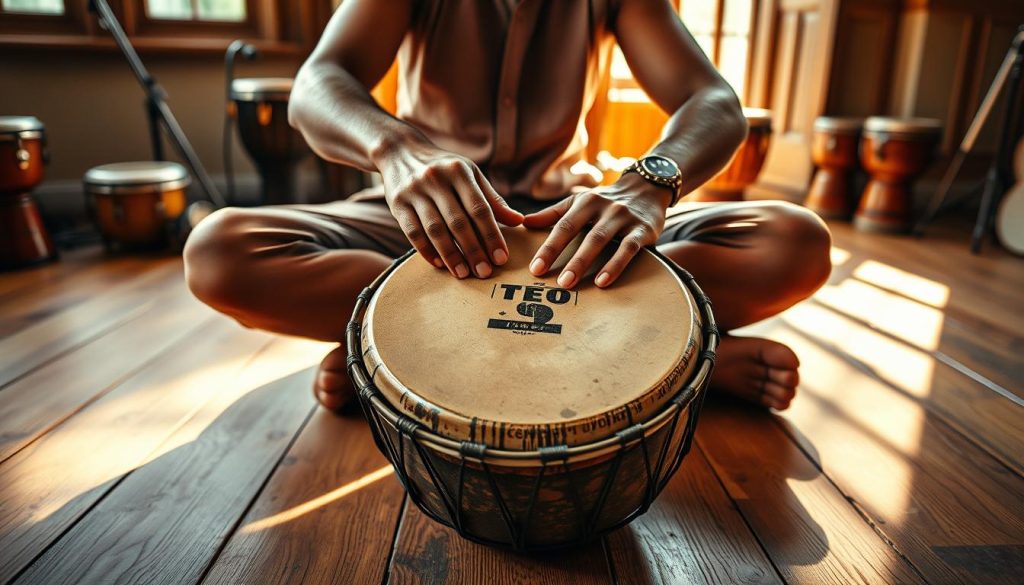
Verify the djembe’s origin and construction
Understanding a drum’s origin helps you assess its quality. Origin can affect wood density, carving style, and tonal consistency. A well-made instrument is rewarding to play.
Distinguish traditional models from factory-made ones
Traditional West African models are recognizable by their balanced goblet shape and narrower foot, which flares gradually. Their height-to-diameter ratio is generally between 1.8 and 2. Slightly irregular carving is often a sign of genuine handcraftsmanship.
By contrast, factory-made models tend to have extremely uniform finishes. This may reflect standardized materials and mass-production methods. You should be able to distinguish handcrafted, partly factory-made, and mass-produced instruments.
Visual clues and regional styles
Visual clues help establish a drum’s origins. A handcrafted instrument, for example, typically has distinctive carving, dense wood, and a natural head, and can offer a rich, lasting sound. Partly factory-made drums have more uniform finishes and a mix of materials, often at a good price for their quality.
Mass-produced instruments, meanwhile, typically show perfect symmetry, identical decoration, and standardized materials. They are often inexpensive, but their sound quality can be inconsistent.
Why the instrument’s history and place of manufacture matter
Ask the seller about the instrument’s history: its approximate age, how often it was played, the maintenance it received, where it was stored, and any repairs. Many drums imported from Africa 15 to 20 years ago are still on the market. Some offer a standard of craftsmanship that is becoming less common today.
Compare what the seller tells you with what you can see. Check the head, ropes, and base. If the instrument sounds good and has a solid structure, its quality matters more than its origin label. A credible account of its origins is still reassuring.
| Construction category | Characteristics | Sound quality |
|---|---|---|
| Handcrafted | Goblet shape, distinctive carving, dense wood | Rich and lasting |
| Partly factory-made | Uniform finishes, mix of wood and standardized materials | Good value |
| Mass-produced | Perfect symmetry, identical decoration | Inconsistent quality |
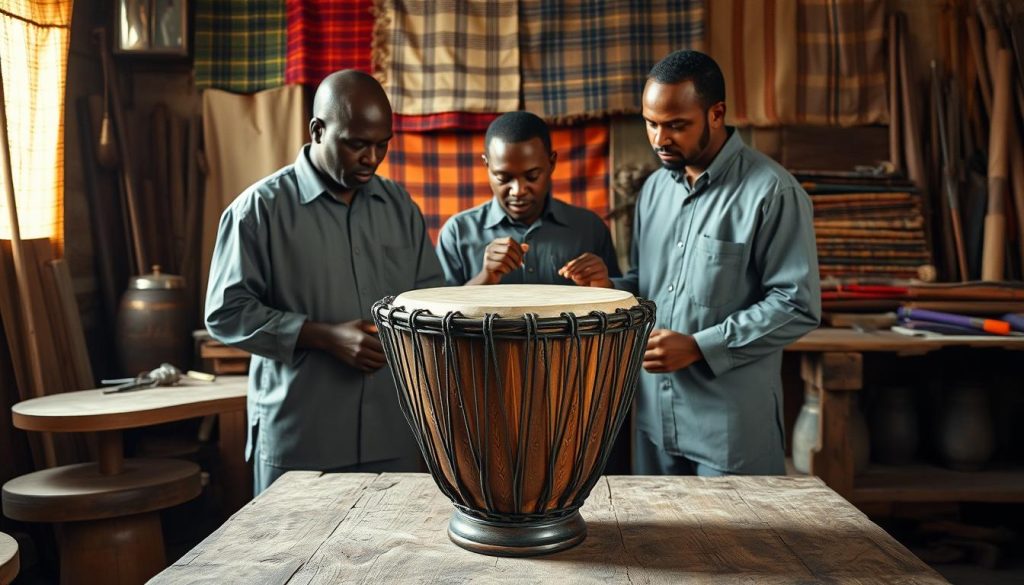
Assess the seller and make the transaction safer
Assessing the seller is an important part of a successful purchase. Someone who is open and available greatly reduces the risk of an unpleasant surprise.
Before you travel to see the instrument, ask a few essential questions:
- Why are you selling this instrument?
- How long have you owned it?
- Where and how was it stored?
- When was it last tuned or repaired?
- Has it been damaged, for example by a fall or exposure to moisture?
Try the instrument in person
There is no substitute for hearing and handling a drum in person. Play it to assess its comfort, and check its overall condition, especially the head and ropes. This will help you spot potential problems.
Tips for a secure, reliable payment
Arrange to meet in a public place. Use a traceable payment method and keep written messages as a record. If you buy through a platform, check the seller’s reputation and the return terms.
A good seller gives specific answers and lets you try the instrument. Their description matches its visible condition. Watch for warning signs, such as refusing a trial or giving evasive answers, which may indicate a lack of transparency.
Ultimately, a transparent seller is often your best protection against scams and poor deals in the secondhand market.
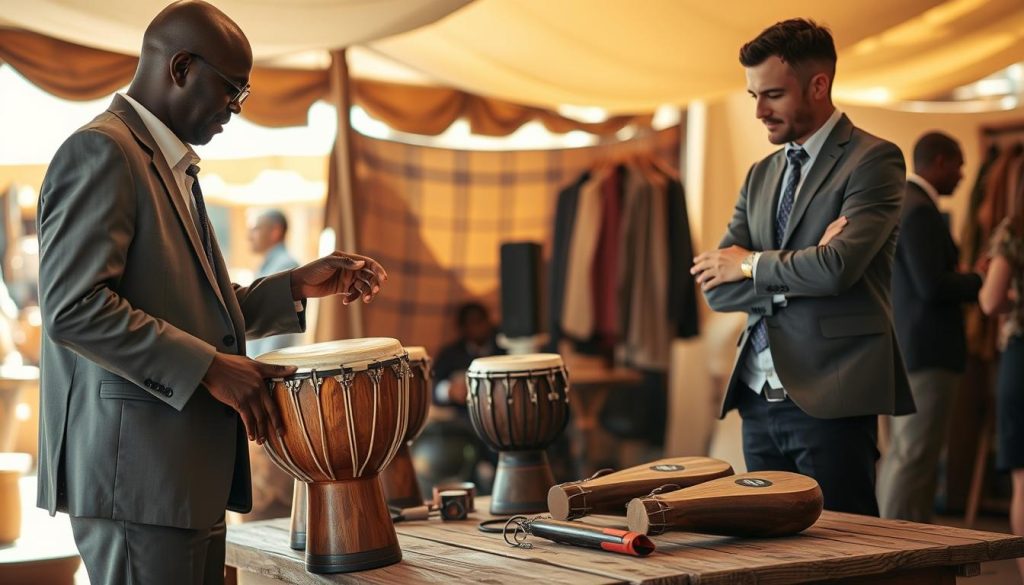
Conclusion: make a purchase that lasts
For a purchase you will enjoy for years, follow a thorough process. Start by setting your budget and deciding how you will use the instrument. Then select three relevant listings so you can compare your options.
During the inspection, check the shell and base, the quality of the head, the condition of the ropes, and the available range for adjusting tension. Test all three fundamental tones to make sure the instrument sounds good.
After buying, store the drum properly. Keep it away from damp basements and hot radiators, and use a breathable case. The head’s tension needs regular seasonal adjustments. Make a habit of checking and caring for the instrument before each session to avoid costly repairs.
If the instrument passes every check and sounds good, it can be a lasting investment in your music. For more buying advice, see this guide.