
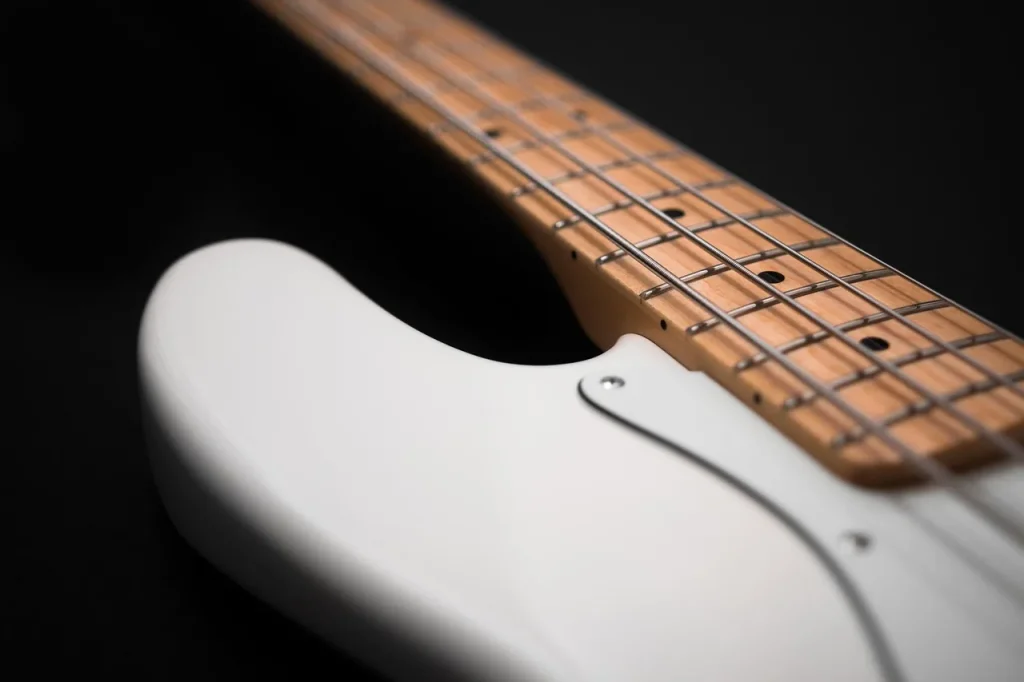
This guide clearly and progressively covers everything a bassist needs to know to improve their understanding of music theory and notation. It connects each concept to the electric bass, from reading bass clef to playing grooves.
The goal is simple: understand how theory supports your everyday playing. You will learn to read sheet music, create a bass line and communicate with other musicians with ease.
This extended article is organized into 12 sections. Each offers practical advice, exercises and practice ideas using a metronome or backing track.
On the site, you will find organized lessons, games and hundreds of exercises. A members’ area offers expanded access: private audio files, statistics and dedicated ad-free pages.
Why music theory benefits bassists
Mastering notation and rhythm changes the way you play and listen to music. A bassist can quickly become more precise by learning a few basics: smoother reading, clear rhythmic reference points and better placement in the groove.
Independence: understanding written music lets you compose and write down ideas to share in rehearsal or the studio. You become less dependent on tablature and more comfortable working with other instruments, especially piano.
Start with the essentials: the staff, clefs, note values and time signatures. Connect each lesson to a short exercise on your instrument. Five minutes a day is enough to establish the basics of sight-reading and make rapid progress.
Learning remains accessible even after years of playing. Follow online articles and exercises, or sign up for practical training for guided instruction. A good site offers games, worksheets and practice activities that help you improve without pressure.
Bass guitar music theory: the essentials you need to know
A good starting point is to distinguish pitch from duration. Lessons often organize the work around two aspects: how high or low sounds are (clefs, notes and accidentals) and how long they last (rhythm, note values and rests).
Concepts to master: the staff, clefs (especially bass clef), key signatures, rhythmic values, rests, time signatures and barlines. Learn these reference points one at a time, then combine them.
How to read sheet music simply
Follow this sequence: identify the clef and time signature, read the tempo, examine the key signature, locate a few reference notes, then work out the intervals. Deal with pitch first and rhythm second before putting them together.
“Practise for 4 to 10 minutes a day: choose consistency over long sessions.”
In practice, begin with individual notes, move on to short patterns, then to fragments of a measure. Use a site with games and PDF worksheets to strengthen your reading. Finally, connect every note you read to a position on the fretboard: recognition becomes faster and more musical.
How to read bass sheet music: notes, staff lines and clefs
Before playing, identify the staff, clef and visual reference points that will guide your fingers. The staff has five lines and four spaces and is read from left to right. Learn to recognize its lines and spaces quickly, then connect them to the fretboard.
The staff, reading direction and the bass clef at the heart of bass playing
In bass clef, memorize a reference note: F sits on the fourth line. Find reference points on the fretboard (open strings and the fifth and seventh frets), and connect every written note to a physical position.

Read notes in bass clef and use treble-clef reference points for related examples
Use treble clef for related examples (the right hand on piano, tutorials). Alternate short sessions in bass clef with a few measures in treble clef to broaden your reading and make it easier to communicate with other musicians.
Accidentals, sharps and flats: where do they appear and how do you read them?
Accidentals in the key signature affect every occurrence of a note on the staff. Individual accidentals (sharps and flats) placed before a note apply until the end of the measure.
- Identify the clef and key signature.
- Read the time signature and scan the pitches.
- Isolate difficult passages.
- Play slowly while subdividing the beat.
- Hear each note in your mind before playing it.
Quick tip: start with two measures in bass clef, anticipate octave leaps and adjust your fingering. Five to eight minutes a day is enough to improve your sight-reading.
Rhythm for bassists: note values, beats and time signatures in action
A measure provides a framework: bounded by barlines, it contains a set number of beats. A 4/4 time signature indicates four beats per measure.
Measures, barlines and 4/4: the basic structure
In 4/4, a whole note fills the measure (4 beats), a half note lasts 2 beats, a quarter note 1 beat and an eighth note half a beat.
Whole, half, quarter and eighth notes: connect each value to its duration
Example: four quarter notes produce four evenly spaced attacks; eight eighth notes let you subdivide into “1-and-2-and.” Practise each value on a single note to refine your attack and sustain.
Internal pulse, rests and practice
Alternate between sessions where you count (“1-and-2-and”) and sessions where you feel the pulse. Use a metronome: start slowly, master the subdivision, then raise the tempo in BPM.
- Record yourself to detect timing shifts.
- Vary the tempo in BPM (slow, medium, fast).
- Routine: 10 minutes a day on simple rhythmic patterns.
“Count, then feel.”
Essential symbols in bass sheet music: dynamics, articulation and repeats
Repeat, dynamic and articulation marks form the visual vocabulary of sheet music. Recognizing these signs before you play prevents surprises and guides your interpretation.

Repeat barlines, dynamics and common directions
First identify repeat barlines and segno and coda signs: they show where and in what order to return. Count the measures and locate the first and second endings.
Dynamic marks (p, f, crescendo, decrescendo) indicate intensity. On bass, adjust your attack, where you pluck the string and the pressure of your fretting hand to achieve the desired sound.
Look for articulations too: slurs, staccato and accents. They affect your fingering and plucking-hand technique.
- Read the tempo and style directions (swing, rubato).
- Make a short checklist before reading: repeats, overall dynamics and articulations.
- Create worksheets and use an educational site for targeted exercises.
“Recording two contrasting versions of the same passage helps you hear the effect of dynamics.”
Scales and the key of a piece: build a musical bass line
A scale is a map that helps you find your way within a piece’s key. It defines the available notes and the overall character of a passage.
Scales and scale degrees: a map of your fretboard
A scale contains seven degrees numbered I through VII. These degrees provide reference points on the fretboard.
Locate the root, third and fifth to guide your choices. These notes often act as pivots when you create a line.

Major and minor scales, relative keys and first reference points
The major scale follows this sequence of intervals: whole step, whole step, half step, whole step, whole step, whole step, half step. The natural minor scale changes the third and produces a darker character.
Relative scales (C major and A minor) share the same key signature. This lets you enrich a line without changing its accidentals.
Example exercise: spend 5 minutes reading scale degrees, then 5 minutes applying them over a simple backing track.
To go further, consult a lesson on scales with worksheets and examples to help you compose music and sharpen your ear.
Chords and roots: read, understand, play
Understanding the relationship between chords and their roots changes how you approach a bass line. A chord is built by stacking thirds: a root, third and fifth, with possible added extensions.

Chord structure and inversions
A major or minor chord is defined by its third. Inversions move the root away from the lowest position. On bass, you need to identify the target note even when the root is not the lowest note.
Connect chord tones and scales to create a line
Simple strategy: play the root on strong beats, add the third or fifth on weaker beats, and connect those notes with diatonic notes.
- Choose a progression (for example, II-V-I).
- List the chord tones and the corresponding scale.
- Sketch several lines: begin with roots, then add stepwise approaches.
Write your ideas on a score so you can write music and share them. Record yourself, listen back and adjust the density of the notes. This work helps any musician or composer write more effectively and refine their ear.
How to read, sight-read and go further: effective methods and routines
Short, focused exercises repeated every day bring quick improvements in reading and rhythm.
Short routine: 4 to 10 minutes a day. Practise reading scores and rhythms without tablature, isolating two measures before gradually extending the passages.
Progressive exercises
Start slowly: two measures at a low tempo. Isolate difficult passages, then repeat them while adding one or two measures.
Metronome work and recording
Vary the tempo in BPM (slow, medium, fast). Put the click on beats 2 and 4, then have it sound every other measure. Record yourself and listen for timing differences.
- Alternate between reading and playing from memory to reinforce your reference points.
- Master one new rhythmic pattern and one new bass-clef reference point each week.
- Combine independent practice, lessons and training to stay motivated.
“A little practice every day is better than a lot once a week.”
To go further, use a site with exercises and games, then gradually add syncopation and offbeats to structure your progress over the years.
Practical bass examples: from a single note to a complete line
These practical examples offer three short routines for applying theory to your playing. They combine reading, rhythm and interaction with drums or a metronome. Before playing, consult a quick guide to reading sheet music to identify rhythms and accidentals.
On one note: rhythmic precision
Simple exercise: on a single note, play whole notes, half notes, quarter notes and then eighth notes. Work on each note’s duration and attack.
Count aloud: “1-and-2-and-3-and-4-and,” then stop counting aloud and feel the pulse. Repeat each pattern 3 to 5 times, then change the tempo.
On the C major scale: connect rhythm and pitch
Play up and down the scale using varied rhythmic patterns. This routine improves your reading and the coherence of your note choices.
Keep your attack even and sustain notes consistently so that reading becomes fluid.
On a line with drums (around 74 BPM): put it into practice
Lock your line to the kick and snare drums. Build two measures of groove, then two measures with a variation to simulate a complete phrase.
- Vary the tempos (slow, medium, fast).
- Record yourself and identify where your line arrives early or late.
- Loop the fragments, then connect them to play the complete line.
Where and how to learn music theory in France today
Today’s learning options range from conservatories to free interactive sites. In official French curricula, the term “formation musicale” has replaced the traditional term “solfège.” This training combines theory, instrumental practice and group exercises.
To progress, choose a format that suits your schedule: a conservatory or school for regular guidance, private lessons for a tailored path, and a well-designed site to supplement your sessions.
Solfège or formation musicale: understanding the difference
Formation musicale takes a broad, contextual approach. It combines rhythm, reading and ensemble practice. The traditional term remains useful, but curricula have evolved.
Lessons, schools, conservatories and sites with games, exercises and accessible options
Conservatories and schools offer group classes, qualifications and concerts. Online platforms offer games, exercise pages and printable PDFs.
- Self-study: reading games, exercises and articles for daily practice.
- Private lessons: teaching adapted to each person’s pace and goals through platforms such as Superprof.
- Members’ area: ad-free access, statistics and additional PDF downloads.
Go further: downloadable guides, articles, videos and member access
Download an updated version of the “Essentials of Music Theory” guide for a printable study plan. Read comments on pages and articles for practical feedback.
“Alternate weekly lessons with daily personal practice for lasting progress.”
| Format | Benefit | Typical resources |
|---|---|---|
| Conservatory / school | Regular guidance and ensemble practice | Group classes, exams, concerts |
| Private lessons | Tailored program | Focused lessons, teacher platform |
| Site / members’ area | Flexible self-study | Games, exercises, PDFs, audio files |
To find a local teacher or a suitable learning path, browse listings of music theory teachers. They are often a good place to start.
Conclusion
Here is a brief summary and some practical ways to keep improving each week.
Summary: mastering the basics of notation, rhythm and musical signs improves your playing and your ear. Even short, regular practice produces clear progress.
Simple action: each day, take a moment to read two measures, practise a rhythmic pattern and apply it on your instrument.
Alternate scale and chord study with rhythm exercises. After three weeks of regular practice, you will gain steadier timing and read more fluently.
To go further, download a complete version of the guide and return to this article often. Share your feedback in the comments to enrich the discussion and learn to think like a composer as well as a performer.