
Quick guide: This article surveys the essential effects that transform your instrument’s sound. It explains how a compressor, drive, and octave pedal can preserve the fundamental frequencies while adding character.
Why they’re useful: A compressor evens out your playing and sustain. Overdrive, distortion, and fuzz add grit without burying the low end. An octave pedal extends the range and enriches layered parts.
We also present a selection of products grouped by category and brand (Strymon, Darkglass, TC Electronic). You’ll learn the recommended effects order: tuner > compressor > overdrive > modulation > delay > reverb.
Who this guide is for: Bassists who want to replace their main pedal or build a pedalboard suited to their style. The sections below compare individual models, multi-effects units, and options that work with both guitar and bass.
Our picks for the best bass effects pedals by category
We’ve grouped proven models by category to help you compare their sounds and controls quickly.
Overdrive, distortion, and fuzz
Tech 21 SansAmp Bass Driver recreates the grit of a tube amp and includes a DI output. The Darkglass B7K Ultra offers a four-band EQ and precise drive switches. The EHX Bass Big Muff Pi delivers deep fuzz that preserves the low end, making it ideal for rock and stoner music.
Transparent and musical compressors
The MXR M87 displays gain reduction with LEDs for immediate feedback. The Darkglass Hyper Luminal combines several types of compression. The EBS MultiComp includes a multiband mode useful for slap bass.
Octave pedals, filters, modulation, and synths
The EHX POG2 tracks across several octaves, while the MXR Bass Octave Deluxe offers two responsive voices. The Aguilar Octamizer produces a warm analog octave. The MXR Envelope Filter responds to playing dynamics and provides a dry/wet mix.
Multi-effects
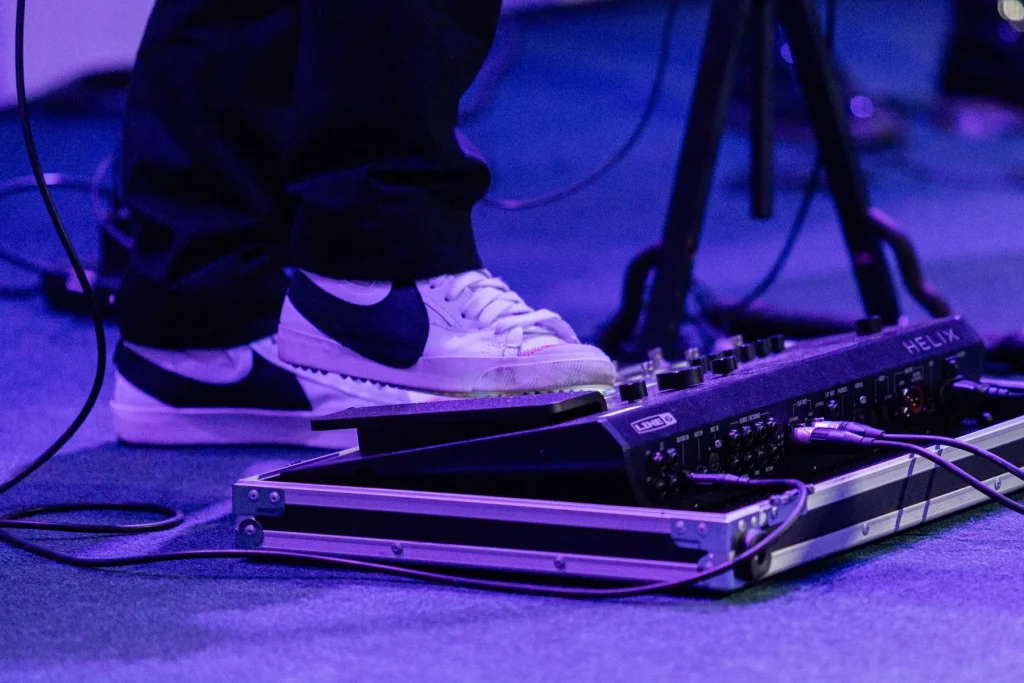
The Line 6 HX Stomp brings together a large library of effects and amp models. The Boss GT-1B and Headrush MX5 offer presets and modern controls. The Zoom B3n remains an affordable way to explore a wide range of effects.
| Category | Key model | Main strength | Recommended use |
|---|---|---|---|
| Overdrive/Distortion/Fuzz | SansAmp Bass Driver / B7K / Big Muff | Amp grit / precise EQ / deep fuzz | Rock, metal, stoner |
| Compression | MXR M87 / Hyper Luminal / EBS | Transparency / several modes / multiband | Sustain, slap, consistent dynamics |
| Octave/Modulation/Synth | POG2 / MXR Octave / Octamizer | Accurate tracking / multiple voices / analog warmth | Textures, layered parts, experimental sounds |
| Multi-effects | HX Stomp / GT-1B / MX5 / B3n | Wide range / presets / modern interface | Stage, studio, playing on the go |
To learn more, read our effects guide and test each pedal with your amp and playing style.
Specialist brands and reliable choices for bassists
Choosing a brand also means choosing a sonic personality. Here’s an overview of the brands shaping modern and classic bass sounds.

Sound profiles and signatures
Darkglass has a modern, cutting sound. The brand’s customization options and the four-band EQs on its Microtubes and B7K pedals appeal to bassists seeking an incisive tone.
Aguilar focuses on quality and musicality. Its preamps and compressors provide a stable tonal foundation, ideal for studio and live use.
EBS prioritizes clarity and efficiency. EBS pedals suit percussive playing that demands precision and articulation.
Tech 21 (SansAmp) makes DI boxes and preamps that add vintage warmth or modern colors, ideal for connecting a bass guitar to a mixing console.
MXR Bass Innovations tailors its effects to low-frequency response, with filters, compressors, and octave pedals designed for the stage.
Modern classics and broad ranges
Origin Effects offers studio favorites such as the Cali76 and realistic preamp platforms. Electro-Harmonix has a wide range of popular models, including the POG2 and Bass Big Muff.
Boss remains a reliable choice, offering durability, variety, and multi-effects units (ODB-3, GT-1B) for players who want to cover several kinds of sound.
| Brand | Strengths | Recommended use |
|---|---|---|
| Darkglass | Modern overdrives, four-band EQ, customization | Aggressive tones, metal, modern rock |
| Aguilar | Premium preamps, musical compressors | Studio work and professionals seeking quality and fidelity |
| EBS | Clarity, effective compressors, tools suited to percussive playing | Slap, funk, precise playing |
| Origin Effects / EHX / Boss | Cali76, POG2, Bass Big Muff, wide range | From standard to experimental sounds, on stage and in the studio |
To explore models in more detail and hear their sounds, read our detailed guide.
Bass pedals: compressor, drive, and octave — how to choose for your style and budget
Your playing style often determines which effect to prioritize. Rock and metal call for overdrive, distortion, or fuzz focused on the low mids. Funk favors a responsive compressor and sometimes an envelope filter. Jazz and soul tend to suit subtle processing and gentle EQ.
Essential settings: gain reduction steadies the level and sustain. A dry/wet mix preserves the attack. A three- or four-band EQ with bass control helps keep low frequencies clear.
Suggested signal chain: tuner → compressor → overdrive/fuzz → modulation → delay → reverb. This order makes gain easier to control and helps preserve signal clarity.
| Criterion | Practical advice | Effect |
|---|---|---|
| Gain reduction | Keep it moderate to avoid clipping | Steady sustain, less noise |
| Dry/wet mix | Preserve the attack with a 30–50% mix | Clarity and body |
| EQ settings | Cut or reduce 80–120 Hz if the sound is muddy | Cleaner low frequencies |
| Budget & buying | Start with one or two pedals and watch the secondhand market | Better value for money in France |
Multi-effects units offer versatility and preset storage; individual pedals often provide more control and better quality for each effect. Some guitar pedals (Big Muff, RAT, DD-7/DD-8, Phase 90, studio reverb) work well on bass, but always test them with your amp and playing style.
Ready-to-play pedalboard examples — practical inspiration
Here are two setups to build on a pedalboard and test at rehearsal or a gig.

Versatile modern setup
An MXR M87 at the start of the chain evens out your playing and displays gain reduction with LEDs. Next, the Tech 21 SansAmp Bass Driver adds amp-like grit and a DI output useful on stage.
The EHX Bass Clone broadens your sound with a chorus that preserves the low end. At the end of the chain, the MXR M82 Envelope Filter adds funky accents with a dry/wet mix and built-in distortion.
- Suggested order: compressor → Bass Driver → modulation → filter.
- Key controls: blend/level, drive/level, depth/rate, sensitivity/mix.
Effective minimalist setup
Choose a trusted compressor (Darkglass Hyper Luminal or Diamond Bass Comp/EQ) and pair it with an analog or multivoice octave pedal (Aguilar Octamizer or EHX POG2).
This pair improves punch, sustain, and the extension of low parts. It lets you create thick lines or melodic layers without weighing down your pedalboard.
Tip: Add light distortion or a boost for choruses if you need a little more bite.
| Type | Benefit | Use |
|---|---|---|
| Versatile | Dynamic control and textures | Live shows, varied grooves |
| Minimalist | Clarity and power | Studio work, solid bass lines |
| Expansion | Possible addition: boost or light distortion | Choruses, solos |
An example favored by bassists: arrange the chain as compressor → octave pedal → modulation/filter, and monitor the gain to keep the low end clean.
Conclusion
In short, building your sound comes down to a few core effects and carefully chosen settings.
Consider the main categories: overdrive, distortion, fuzz, compressors, octave pedals, modulation, filters, synths, and multi-effects. Models from SansAmp, Darkglass, EHX, MXR, Boss, Aguilar, and Origin Effects provide dependable starting points.
Prioritize low-end clarity: pay attention to gain reduction, blend, and EQ settings. A good bass compressor or a pedal inspired by the Origin Effects Cali76 can become the foundation of your signal chain.
Test pedals in context with your amp and band, and expand your palette gradually. To compare effective compressors, read our guide to the best compressor pedals.