
This article helps you see the differences between two legendary models at a glance. Introduced in 1951 and joined by a second design in 1960, this pair covers most modern playing needs.
Background: both basses often have an alder or ash body, a maple neck, and a maple or rosewood fingerboard.
Their shapes and electronics differ: one has a silhouette similar to a Stratocaster, while the other has an ergonomic offset body. One uses a noise-canceling split pickup; the other uses two single-coil pickups.
Ultimately, the choice depends heavily on how the neck feels, the weight, the ergonomics, and the kinds of bass lines you play. We will examine the bodies, necks, pickups, and hardware, and offer practical pointers drawn from real experiences in stores.
Fender Precision vs Jazz Bass: Which One Is Right for You?
In the 1950s and 1960s, a quiet revolution changed how bassists held and played their instruments.
A brief history lesson: from Leo Fender to the DNA of two iconic models (1951 vs 1960)
1951 marked the arrival of the Precision Bass: a body often made of alder or ash, a maple neck, and a maple or rosewood fingerboard.
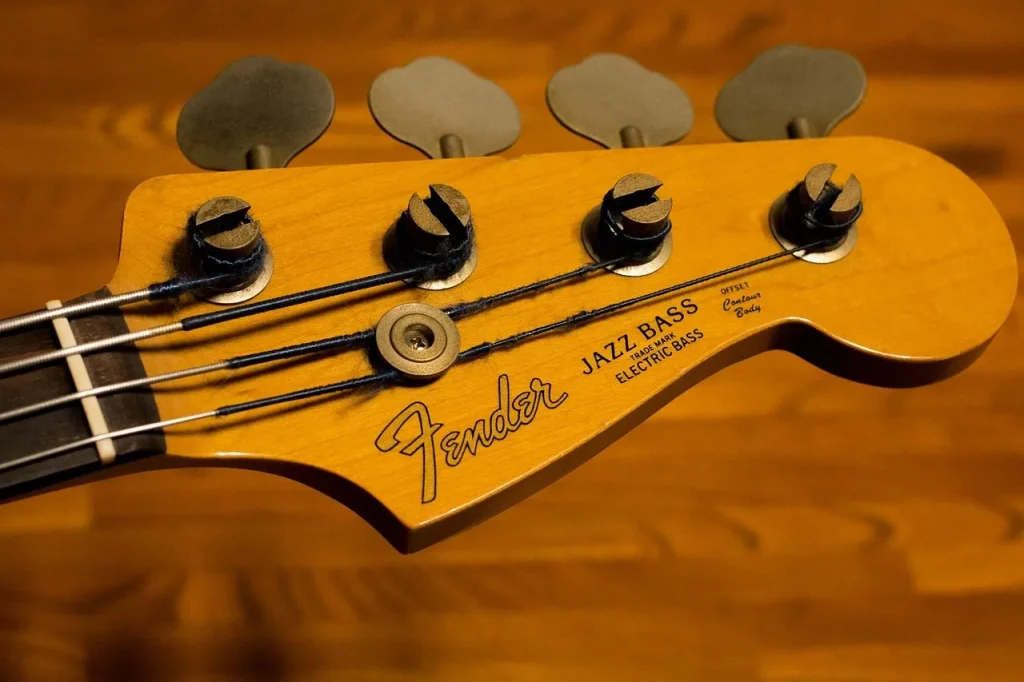
1960 brought the Jazz Bass, with an offset body inspired by the Jazzmaster and a narrower neck designed to ease the transition from double bass.
Early Jazz Bass models used stacked knobs from 1960 to 1963, before the two-volume, one-tone configuration appeared in 1962. This change simplified the controls and broadened the tonal range.
This new approach did not replace the Precision Bass: it complemented it. The materials remained similar, but the playing experience differed: stability and a solid foundation on one side, articulation and nuance on the other.
- Original aim: frets for greater accuracy and an instrument that was easier to carry.
- Timeline: 1951 (Precision Bass) / 1960 (Jazz Bass).
- Impact: both models continued to evolve across successive series and were adopted by many bassists.
| Year | Model | Key feature | Controls |
|---|---|---|---|
| 1951 | Precision Bass | Wide neck, split pickup, solid foundation | Volume + tone (classic configuration) |
| 1960 | Jazz Bass | Offset body, slim neck, two pickups | Stacked knobs (1960–1963) → two volumes + one tone (1962) |
| Later years | Both models | New series and active and passive options | Configurations vary by series |
Iconic bassists such as Jaco Pastorius helped build the legend, particularly around fretless tone and the Jazz Bass’s versatility. For a detailed look at the differences between a Jazz Bass and a Precision Bass, consult this guide.
Differences between the two models: construction, necks, pickups, and electronics
The wood, neck, and electronics immediately shape how an instrument behaves.
Body and wood
Alder remains a common choice for its balance and dynamic response. Ash adds brightness and can make the instrument lighter, affecting its tone and sustain.
The symmetrical shape helps the bass balance when you stand, while the offset body improves comfort when seated and access to the upper frets.

Neck and fingerboard
Nut width differs: approximately 41.3 to 44.5 mm on the wider model, compared with 38 mm on the slimmer neck. This difference changes the feel and playing speed.
A maple fingerboard gives notes a crisp attack; rosewood produces a warmer, rounder sound. This choice affects the definition of bass lines and the attack of the strings.
Pickups, placement, and electronics
A split pickup wired in series delivers a richer midrange sound and naturally reduces background hum. The two-pickup design offers more brightness and finer control over tonal character.
On the two-pickup model, the pickup near the bridge adds clarity and dynamics for slap and articulate playing.
Electronic options include historical stacked knobs, the S-1 switch (series/parallel), and active 18 V (Deluxe USA) or 9 V (Deluxe Mex) versions. Noiseless pickups and reinforced necks also change the result.
Bridge, hardware, and manufacturing
Vintage, top-load, strings-through-body, and Badass II/III bridges affect sustain and attack. These instruments are made in the United States, Mexico, Japan, China, Indonesia, and Korea.
String tip: flatwound strings soften the sound and emphasize punch in the studio, while roundwounds favor brightness.
To try several configurations and models, explore this comparison before visiting a store.
Sounds, styles, and uses: from rock bass to jazz fusion
Sound often guides the choice: punch, clarity, or the ability to adapt to a particular style.
Signature sound: the Precision Bass delivers firm lows and prominent mids. This tone provides an excellent foundation for rock, punk, and pop bass lines.
Thanks to its two pickups, the Jazz Bass offers a brighter, more nuanced range of sounds. Its bridge pickup adds clarity and attack, which are useful for slap and articulate passages.
Playing context: in the studio, flatwound strings on a Precision help it sit steadily in the mix. Onstage, the Jazz lets you shape your sound by blending the pickups.
Many famous bassists illustrate these uses: Jamerson for Motown groove, Steve Harris for speed in heavy metal, Duff McKagan for straight-ahead rock, and Jaco Pastorius for the jazz fusion revolution with a fretless Jazz Bass.
| Use | Sound profile | Example bassist |
|---|---|---|
| Supporting bass lines | Steady lows, strong mids | James Jamerson |
| Articulate playing / slap | Brighter sound, bridge-pickup attack | Marcus Miller |
| Fusion / fretless | Nuance, rich harmonics | Jaco Pastorius |
Practical advice: try different pickup heights, pickup selections, and strings. To explore the historical and technical differences further, read this comparison before visiting a store: comparison guide.
Conclusion
The decision depends above all on how the neck feels and how the bass sounds in a real playing situation. The Precision Bass retains its reputation for punch and a solid foundation, while the Jazz Bass offers greater versatility through its two pickups.
Differences in nut width (38 mm versus 41.3 to 44.5 mm) significantly change how the instrument feels in your hands. The neck profile, weight, balance, maple or rosewood fingerboard, and bridge setup all affect comfort and intonation.
Try several series and models in the same store at a realistic volume, then immediately note your impressions of comfort, response, and dynamics. The wood, particularly alder, the strings, and the pickup height can be adjusted to suit your goal without changing instruments.
There is no single right answer: the two models complement each other. To learn more, this overview of the Fender Precision explores series and options you can try in a store.